High Limit Scratchcards and Instant Wins: Can You Avoid Document Checks?
No document upload does not mean no identity checks. Understand verification, scratchcard limits and the limits of high-stakes claims before comparing games.

Introduction
You may be able to have your identity checked without uploading documents, but that is not the same as gambling without verification. The Gambling Commission says online gambling businesses must verify age and identity before you gamble. Its guidance also explains that businesses can often check your details against existing databases instead of asking for document copies.
If you searched for “high stakes instant win games no kyc uk”, that distinction matters more than a promise of zero paperwork. KYC means “know your customer”: checks used to establish who a customer is. Neither official source used here establishes a high-limit instant-win service available to UK readers with no identity checks or a guarantee that documents will never be requested.
This guide is for adults aged 18 and over. The Gambling Commission guidance concerns its regulatory remit in Great Britain; it should not be read as a complete account of Northern Ireland’s gambling rules.
No document upload is not the same as no KYC
According to the Gambling Commission’s age, ID and financial verification guide, a business can often match account details with information held by credit reference agencies or the electoral roll. If that information is insufficient, it may ask for copies of identification documents.
That provides a practical explanation for a registration process with no upload screen: a check may still have happened electronically. It does not establish that the account is anonymous or exempt from later requests.
The Commission lists passports, driving licences and household bills as examples of documents a business may request. It does not prescribe one document list for every operator. Electronic verification may be instant, but the regulator gives no universal completion time, and document checks can take longer.
For readers concerned about privacy, the useful comparison is what data a business needs, why it needs it and how its privacy policy says it will handle it. Do not interpret “no documents at registration” as a promise of no checks throughout the account’s lifetime.
What high limits actually tell you
A large advertised prize is not a large permitted stake. The price of one game, the maximum prize and the amount you can spend across repeated games describe different things. A withdrawal limit is different again: it concerns taking money out rather than buying a game.
Before comparing scratchcards or online instant-win games, look for the following in the current official rules:
| Detail | What it helps you understand |
|---|---|
| Price per card or game | The cost of one purchase, rather than the size of the headline prize |
| Prize information and published odds | What the advertised prize means and how the game describes its chances |
| Purchase, play and spending limits | Restrictions on how much or how often you can participate |
| Eligibility and verification requirements | Whether the service accepts you and what checks apply |
| Prize-claim and withdrawal terms | How payment works and what additional information may be needed |
The supplied official pages do not provide a current catalogue of high-stakes games, game-specific odds or a universal maximum stake. They therefore cannot support a ranking of high-limit providers. Where an operator does not clearly disclose a relevant condition, treat that as missing information, not permission to assume there is no restriction.
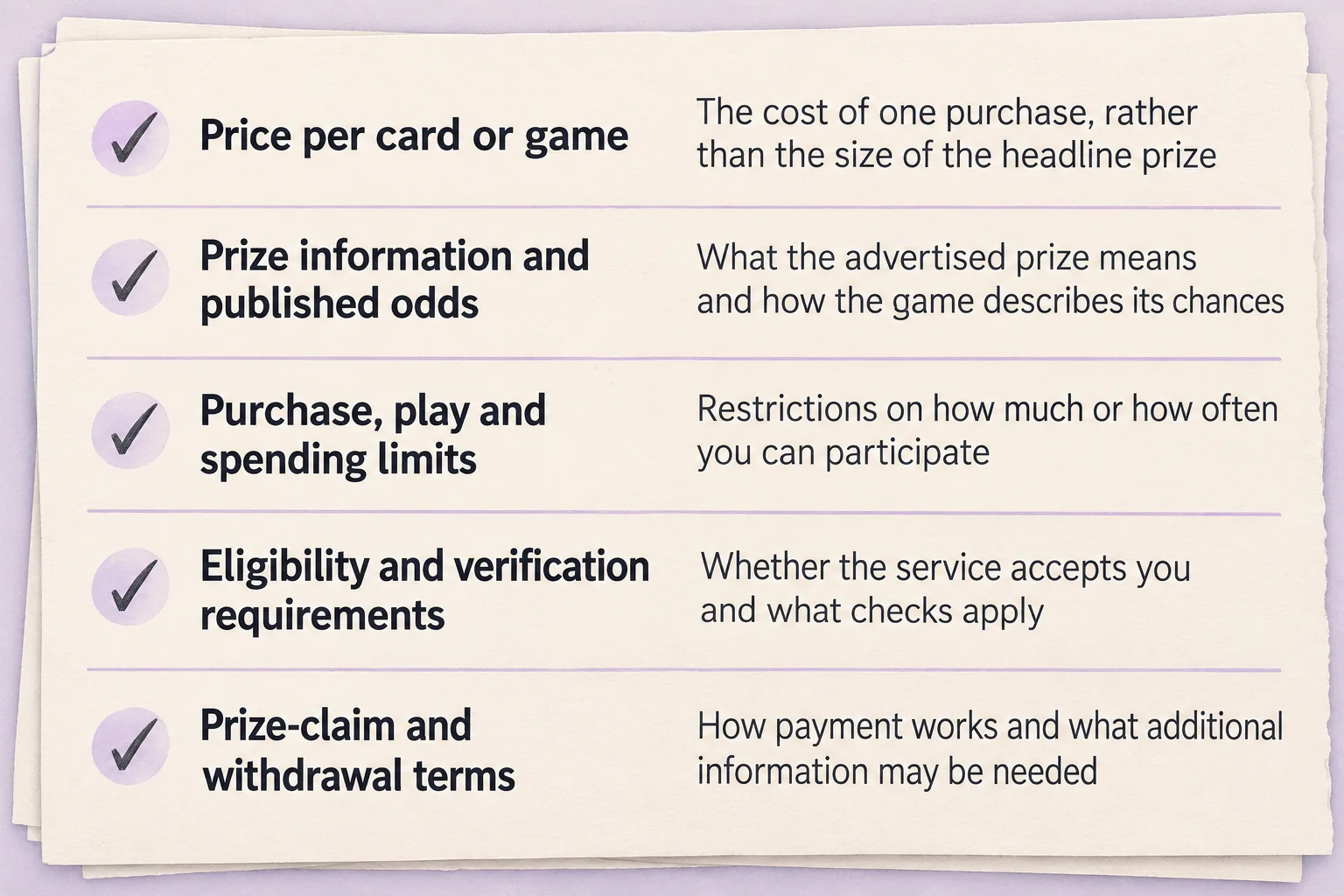
Details to check in current official rules and what they help you understand.
Scratchcards and online instant wins: the National Lottery example
Allwyn’s participant-protection page gives a concrete example of why retail scratchcards and online games should not be treated as interchangeable routes to unrestricted play. These are National Lottery measures described by Allwyn, not rules for every casino.
Retail scratchcard purchases have a stated limit
Allwyn says it introduced a policy in October 2024 limiting in-store scratchcard purchases to no more than 10 at a time in a single store visit. This is a purchase-count restriction, not a monetary stake limit or evidence that a particular high-priced card is available.
The same page describes retailer age-verification checks. Buying in a shop should not be presented as a way to avoid age controls, and the purchase limit does not establish the documentation needed to claim a prize. Consult the relevant game’s official claim rules for that separate question.
Online instant-win play includes identity checks and controls
For online National Lottery players, Allwyn describes rigorous age and identity verification, daily play limits, and weekly deposit and spend limits. It also states a £50 first-deposit limit for new online customers. That figure is a first-deposit restriction, not a maximum game price or a general weekly allowance.
Allwyn also describes time-based limits for online Instant Win Games, including an enforced break during continuous play. Its page says players returning from a significant break can no longer play online Instant Win Games, but it does not define the duration of that break in the supplied text. Existing access should therefore not be assumed to guarantee future availability.
These measures support a clear conclusion: the National Lottery is not evidence of a high-stakes, no-verification option. Its stated approach is responsible participation, including limits and checks.
Could documents still be requested when you withdraw?
Yes, additional information can be needed later. However, the Gambling Commission says a business cannot make proving age and identity a withdrawal condition if it could have requested that information earlier. It also recognises that legal obligations may require information at that point.
The distinction is between an avoidable late request and a request that becomes necessary later. The regulator says businesses needing further information, for example for anti-money-laundering checks intended to prevent criminal funds entering gambling, should request it promptly rather than wait until withdrawal.
Passing an initial electronic check is therefore not a guarantee of a document-free payout. Nor does every later request automatically establish wrongdoing. Ask the operator what information it needs and why. If a dispute remains unresolved, our guide to casino complaints and alternative dispute resolution explains the complaint topic in more detail.
Compare the conditions, not the zero-checks promise
For this search, the first question is whether an advertised service genuinely accepts your location and meets the applicable licensing requirements. Neither supplied source verifies an individual casino’s availability, licence, game range or payout terms. This article does not recommend a provider on that basis.
Keep any bonus offer separate from the game’s ordinary rules. A bonus may have its own conditions; the guide to casino bonus wagering requirements explains that separate comparison. No offer or wagering term has been verified here.
If avoiding document uploads is your main concern, ask whether electronic verification is available and what happens if it fails. Do not use false details or attempt to get around identity checks, purchase limits or self-exclusion.
Keep instant-win play within a limit you can afford
An instant result does not make a game a reliable way to earn money. Repeated purchases still cost money, and a larger permitted spend is not a benefit if it exceeds your budget. Do not borrow to gamble or increase spending to recover losses.
Allwyn describes options including breaks from all games and exclusions specifically from Instant Win Games. Its participant-protection page also signposts GamCare and other support services. If gambling is becoming difficult to control, stop playing and seek support rather than searching for a service with fewer checks.
The useful distinction is simple: fewer uploads can mean electronic verification, not fewer safeguards. Check current official eligibility, game limits and verification terms before considering participation. Where those details are missing, there is no sound basis for treating a “zero document checks” claim as a guarantee.
Related guides
What to check before choosing a payment method
A practical checklist for reading deposit and withdrawal information.
Online Casino Easy Verification: A UK Guide to Faster Onboarding
Learn how online casino easy verification works in the UK, what documents you need, and how to avoid delays during identity checks.
How to assess a fast-withdrawal casino claim
An evidence checklist for payout-speed claims: licence, payment route, timing definitions, verification and a documented complaints route.