No KYC Live Dealer Casinos: High Stakes Baccarat and Roulette Without ID
What no-ID claims mean for live baccarat and roulette, why verification still applies in Great Britain, and which high-stakes limits need checking.

Can you play high-stakes live casino games without ID?
A live baccarat or roulette table showing a high maximum bet does not prove that you can play without identity checks. Online casinos licensed to serve consumers in Great Britain must verify age and identity before gambling. Electronic verification may remove the need to upload documents, not the requirement to be verified.
If you searched for “no kyc live casino uk high stakes”, test the claim in separate parts: how identity is checked, whether further financial information may be needed, what the exact table permits and what the account terms allow. A satisfactory answer to one does not settle the others. This guide explains what evidence to look for without recommending a no-ID operator.
It is for adults aged 18 and over comparing casinos. The official sources cover Great Britain, meaning England, Scotland and Wales, rather than establishing Northern Ireland’s rules. No named operator, current casino availability or numerical live-table limit has been verified here.
What “no KYC” means when no passport is requested
Checks establishing who a customer is are commonly called know-your-customer checks, or KYC. The Gambling Commission’s age, ID and financial verification guidance explains that operators can often match account details against databases. If that is insufficient, they can request documents.
Start by separating the method from the result. An operator’s explanation that it uses electronic checks describes a method; it does not confirm that your own checks are complete. Look for an explicit account status or ask official support whether age and identity verification is complete and whether anything remains outstanding. Do not use a deposit or test bet to resolve that uncertainty.
For example, the Commission describes matching details against credit reference agencies and the electoral roll. That explains how a player might be verified without sending a passport. It does not establish access to any particular live table or promise instant completion for every customer.
A live dealer or overseas licence does not replace UK authorisation
Before assessing a no-ID claim, establish which business makes it. Record the operator’s legal name and the domain where the account would be held, then check them against the Commission’s public register through its official website. A live dealer presents the game remotely; the studio name alone is not evidence about the operator accepting your money.
The Commission’s remote sector guidance requires its licence to serve consumers in Great Britain, including from abroad. Its illegal gambling guidance confirms that an overseas licence does not replace this authorisation. If you cannot establish the operator and its authorisation, leave the account unfunded rather than investigating access by playing.
High-stakes baccarat and roulette: which limits matter?
Use the following sequence to assess the combined promise of no-ID access and high-stakes live play. It is a checklist for examining evidence, not confirmation that any casino meets these conditions. Keep the relevant terms and written answers together so that a statement about the table is not mistaken for a statement about your account.
| Part of the claim | Evidence to look for | What it does not establish |
|---|---|---|
| Identity checks are complete without document upload | The operator’s explanation of its checking method, plus confirmation of your own verification status | That further financial information will never be requested |
| No further financial questions will arise | Published information about financial checks and a clear answer about any outstanding account requests | A permanent exemption from legal obligations, even after an initial check |
| The advertised live bet is permitted | The exact table name and current rules covering the particular bet, rather than a general high-stakes banner | That your account is verified or can fund that bet |
| The account permits the proposed activity | Account-specific restrictions and applicable deposit or loss limits, considered separately from table rules | That a table maximum is affordable or a withdrawal will be unrestricted |
| Withdrawals will not require documents | Withdrawal terms read alongside verification requirements and any explanation of an outstanding request | A guarantee that no later legally required information can be sought |
The financial-check stage needs particular care. The Commission describes requests for bank statements to check that funds are legitimate and questions about income. These can relate to preventing money laundering, meaning criminal money entering the gambling system, and concerns about financial harm. A completed identity check answers who you are, not every question about the money used to gamble.
Ask whether a financial request is currently outstanding and where the operator explains possible further checks. An answer about today’s status cannot guarantee that no future request will be necessary. The supplied official evidence gives no universal high-stakes threshold for baccarat or roulette and no single amount below which all further checks are ruled out.
Table and account limits also answer different questions. A maximum stake concerns the game’s permitted wager; a deposit limit concerns money entering the account. Withdrawal conditions concern money leaving it. If a promotion is involved, check its eligible games and restrictions separately. None of these terms can substantiate a promise that identity checks disappear.
Baccarat: read the rules of the exact variant
Match the advertised baccarat table to its actual rules before treating a high-stakes claim as meaningful. Identify the bet being discussed, such as Player, Banker or Tie, which are named betting choices in baccarat. Check any commission or separate side-bet conditions in those rules rather than assuming a headline applies throughout the game.
Then return to the no-ID claim: does the operator’s answer refer to identity verification, financial checks or merely the table’s betting allowance? A reply quoting a maximum bet does not answer whether verification is complete. Ask for the account question to be answered separately.
For the fuller comparison of betting limits and payout conditions, see our guide to high-limit baccarat. Here, the question is whether evidence about that table actually supports the accompanying verification promise, not which variant offers the largest allowance.
Roulette: distinguish table branding from bet limits
For a roulette claim, put the operator and domain beside the exact table name and rules, then compare these with the operator’s separately published verification conditions. This helps identify an unanswered question: do the terms describe the account you would use, or is the advertisement showing only a game interface?
An accessible interface or displayed maximum establishes neither absence of identity checks nor authorisation to serve you. If support answers an identity question by pointing to the roulette screen, the question remains unanswered. Do not infer a special roulette exemption from a table label.
No roulette-specific KYC threshold is established by the sources used here. The remote guidance’s link to online slots stake limits is not evidence of a live-table cap or a verification exemption.
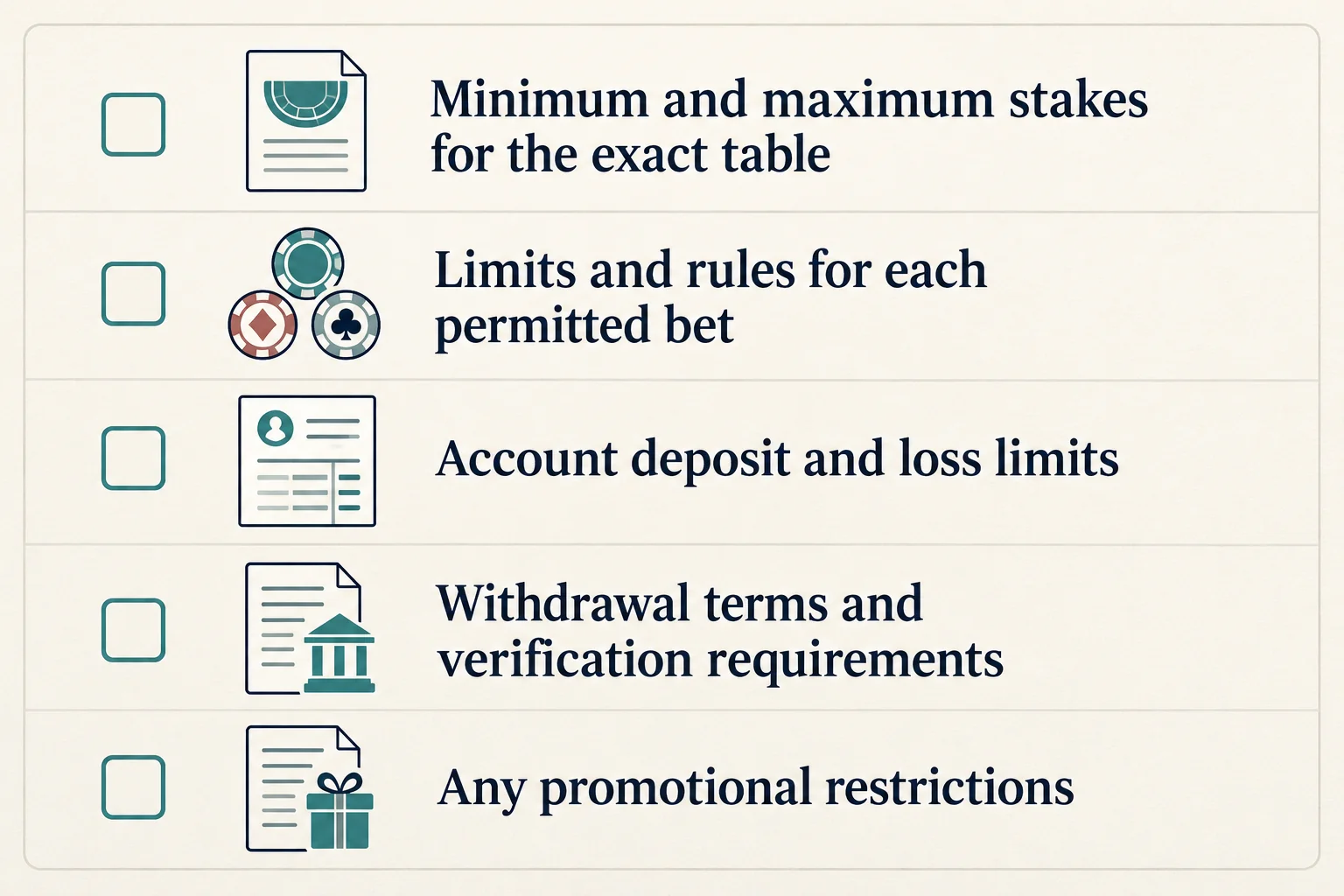
Check table, bet and account limits separately from withdrawal and promotional conditions.
Can a casino ask for ID when you withdraw?
The Commission says an operator cannot make age and identity verification a withdrawal condition if it could have requested the information earlier. However, information may be needed at that point to meet legal obligations. Additional requests, including for anti-money laundering checks, should be made promptly rather than held until withdrawal.
For this comparison, the practical test is whether a “no-ID withdrawal” claim acknowledges those qualifications. Neither a completed identity check nor permission to place a live bet proves that a future withdrawal will require no information.
If money is already delayed, ask what is missing, why it is required and how to submit it securely. Keep the correspondence. Our guide to casino complaints and alternative dispute resolution covers escalation if the explanation is unsatisfactory. Do not send sensitive documents through unsolicited messages or unverified contacts.
Comparing privacy claims without looking for a bypass
A useful enquiry names the account and table separately: “How is age and identity verified? Are any checks outstanding on my account? Where are the financial-check and withdrawal requirements? Which rules apply to this named live table?” These questions seek explanations, not a way around checks. A generic assurance that a casino is “VIP-friendly” would leave them unresolved.
Read the privacy information and confirm the official document-submission route if documents are needed. If the answers conflict, ask the operator to explain the discrepancy in writing; do not assume the least restrictive statement overrides the others. You can choose not to open or fund an account. Do not use false details or attempt to bypass restrictions.
Our guide to fake no-verification casino warning signs covers the broader marketing issue. For live play, keep the narrower question in view: which part of the advertised promise has actually been explained, and which remains unsupported?
Questions readers ask about no-ID live casino claims
Does electronic verification count as KYC?
Yes. It is a checking method, not an exemption. For a particular account, establish whether that check has completed rather than relying on the absence of an upload request.
Does playing for higher stakes remove verification requirements?
No. Table rules do not waive pre-gambling age and identity checks. Nor do the supplied sources identify one stake amount that triggers every additional financial check.
Does an overseas licence make a no-KYC casino suitable for British players?
No. For consumers in Great Britain, establish the operator’s Gambling Commission authorisation. A foreign licence or familiar live studio is not a substitute.
Keep the decision separate from the table limit
A maximum bet is a ceiling in the game’s rules, not a spending recommendation. Higher stakes put more money at risk on each bet; they do not guarantee a favourable outcome. Do not borrow to gamble, chase losses or use money needed for essential costs.
If you choose to gamble, set an affordable spending limit and a time limit beforehand. Stop if you find yourself trying to recover losses or struggling to keep to those limits. Consider self-exclusion and seek gambling support through the NHS or a specialist service if gambling is causing harm.
Keep unanswered points visible: verification status, possible financial requests, exact table rules and independent account conditions. Do not turn a confirmed table maximum into an assumed no-ID promise. If the operator cannot give clear answers, leave the account unfunded.
Related guides
What to check before choosing a payment method
A practical checklist for reading deposit and withdrawal information.
Online Casino Easy Verification: A UK Guide to Faster Onboarding
Learn how online casino easy verification works in the UK, what documents you need, and how to avoid delays during identity checks.
How to assess a fast-withdrawal casino claim
An evidence checklist for payout-speed claims: licence, payment route, timing definitions, verification and a documented complaints route.