Tax-Free Winnings & No KYC: Can UK Players Keep 100%?
Offshore status does not create a special UK tax exemption. Understand the difference between gambling winnings, operator duties and withdrawal checks.

Are offshore casino winnings tax-free for UK players?
For an ordinary UK player gambling on their own account, casino winnings are generally not taxable as trading income. Going offshore is not what creates that treatment, and avoiding identity checks does not create a tax exemption. Neither point guarantees that you will receive every pound shown in a casino balance.
If you are searching for “tax free casino winnings offshore uk”, separate two questions: whether your winnings are taxable and whether the casino will release the amount you expect. HMRC guidance addresses the first. Licensing rules, identity checks and the applicable withdrawal terms matter to the second.
This guide is for adults aged 18 and over. It explains the ordinary-player position, not a route to evade tax or verification. The Gambling Commission rules discussed below concern Great Britain: England, Scotland and Wales. They should not be treated as a complete account of Northern Ireland’s gambling law.
What HMRC says about gambling winnings and exceptions
HMRC’s Business Income Manual, BIM22015 states: “The basic position is that betting and gambling, as such, do not constitute trading.” In plain English, placing bets does not by itself turn your gambling into a taxable business.
That is the useful starting point for an individual casino player. It is not a promise that every receipt connected with gambling has the same tax treatment.
Gambling yourself is different from running a gambling business
HMRC draws a distinction between a person placing bets and an organised activity making profits from the gambling public. The latter will normally amount to trading. Its manual also points to separate guidance on professional gamblers, organised activity and gambling that forms an element of an existing trade.
The practical distinction is what you are doing, not simply the size of a win. A person playing a game on their own account and a business organising gambling for customers are not in the same position. Do not apply the ordinary-player answer to business income or other payments merely because gambling is involved.
BIM22015 gives a specific illustration using spread betting: the person placing the bet is not normally trading, so profits are not taxable and losses receive no relief, subject to the exceptions in HMRC’s further guidance. The bookmaker organising the bet is taxable on its profits. That example explains the player-versus-business distinction; it does not settle every casino player’s personal circumstances.
If your activity overlaps with a business, or another country’s tax rules may apply to you, seek individual tax advice. The sources here do not establish the treatment of every cross-border arrangement or foreign withholding rule.
Offshore does not mean outside British licensing rules
“Offshore” describes a business based abroad. It does not tell you whether that business is licensed to serve you, whether its terms are fair, or whether a withdrawal will be straightforward.
The Gambling Commission’s remote sector guidance says that businesses providing remote gambling to consumers in Great Britain need its licence, including businesses based abroad. Its example is a Malta-based business whose website or app can be played by people in England, Scotland or Wales.
An overseas address and a Gambling Commission licence can therefore coexist. Equally, a foreign licence alone does not establish that an operator meets the Commission’s requirement for serving Great Britain. Check the operator’s identity and licensed status through the Commission’s Public Register rather than relying on a badge or a tax-free slogan.
The HMRC guidance cited here does not identify a special personal tax advantage created by choosing an offshore casino. Treat a claim that you must go offshore to keep winnings tax-free with caution.
Operator gambling duties are not a tax bill on your win
HMRC’s guidance on gambling duties concerns the businesses supplying betting and gaming. For remote gaming, it describes a duty on provider profits from play by customers who usually live in the UK, regardless of where the provider is based.
The guidance lists Remote Gaming Duty at 40% on or after 1 April 2026. That is a provider duty rate, not a statement that a player loses 40% of a casino withdrawal to HMRC.
This distinction matters if a casino describes a deduction as “UK gambling tax”. The cited guidance does not establish a standard deduction from an ordinary player’s winnings to cover that duty. Ask for the legal basis, the relevant term and an itemised explanation. Do not assume that an operator tax makes an unexplained charge legitimate.
For a deduction described as foreign withholding, the UK sources alone cannot confirm whether it is required. You would need the applicable jurisdiction’s rules and advice relevant to your circumstances.
No KYC does not mean no identity checks
KYC means “know your customer”: checks used to establish who a customer is. Tax treatment and identity verification answer different questions. Providing identification does not, by itself, make ordinary gambling winnings taxable.
The Gambling Commission’s age and ID verification guidance says that online gambling businesses under its rules must verify age and identity before a customer gambles. A “no KYC” promise is not an exemption from those requirements.
No document upload is not the same as no verification
The Commission explains that businesses can often check details against existing databases. If those checks are insufficient, they may request documents such as a passport, driving licence or household bill. A player who does not upload documents may still have been verified electronically.
The Commission does not give a universal completion time. Electronic checks may be instant; document checks may take longer. Neither “no paperwork” nor “fast verification” establishes that all later checks are impossible.
Can a casino ask for documents when you withdraw?
Under the Commission’s rules, a business cannot make withdrawal conditional on age or identity information it could have requested earlier. However, a legal obligation arising at that stage may justify a new request. The guidance specifically recognises checks intended to prevent money laundering and says businesses needing more information should ask promptly, not simply wait until withdrawal.
A request is therefore not automatically improper, but its timing and reason matter. Ask which information is missing and why it is needed now. For practical problems with submitted paperwork, see our guide to casino verification documents being rejected.
Why tax-free does not guarantee retaining 100%
“Retaining 100% of your big hits” combines a tax claim with a payout promise. The official sources support neither a universal payout guarantee nor an assurance that every offshore operator pays without deductions or checks.
Before treating a displayed balance as money available to withdraw, establish the following:
| Question | What to look for |
|---|---|
| Is this cash or a bonus-linked balance? | The terms that govern withdrawal and any applicable wagering conditions. |
| Is there a payment charge or currency conversion? | The stated fee and conversion terms, rather than an assumption that tax-free means cost-free. |
| Has the operator requested verification? | The reason for the request, the documents required and when the request was made. |
| Is a deduction described as tax? | The jurisdiction, legal basis and calculation in writing. |
| Is the payout disputed? | The operator’s complaints procedure and the dispute route applicable to that business. |
These are checks to make, not claims that every casino applies each condition. The sources supplied do not verify any particular operator’s fees, payout limits or bonus terms. Our explanation of casino bonus wagering requirements covers the separate question of bonus conditions.
Keep account statements, withdrawal confirmations and correspondence if a payment is disputed. For a complaint involving a relevant British-licensed business, our casino complaints and alternative dispute resolution guide explains that separate process. A tax rule alone cannot resolve a contractual payout dispute.
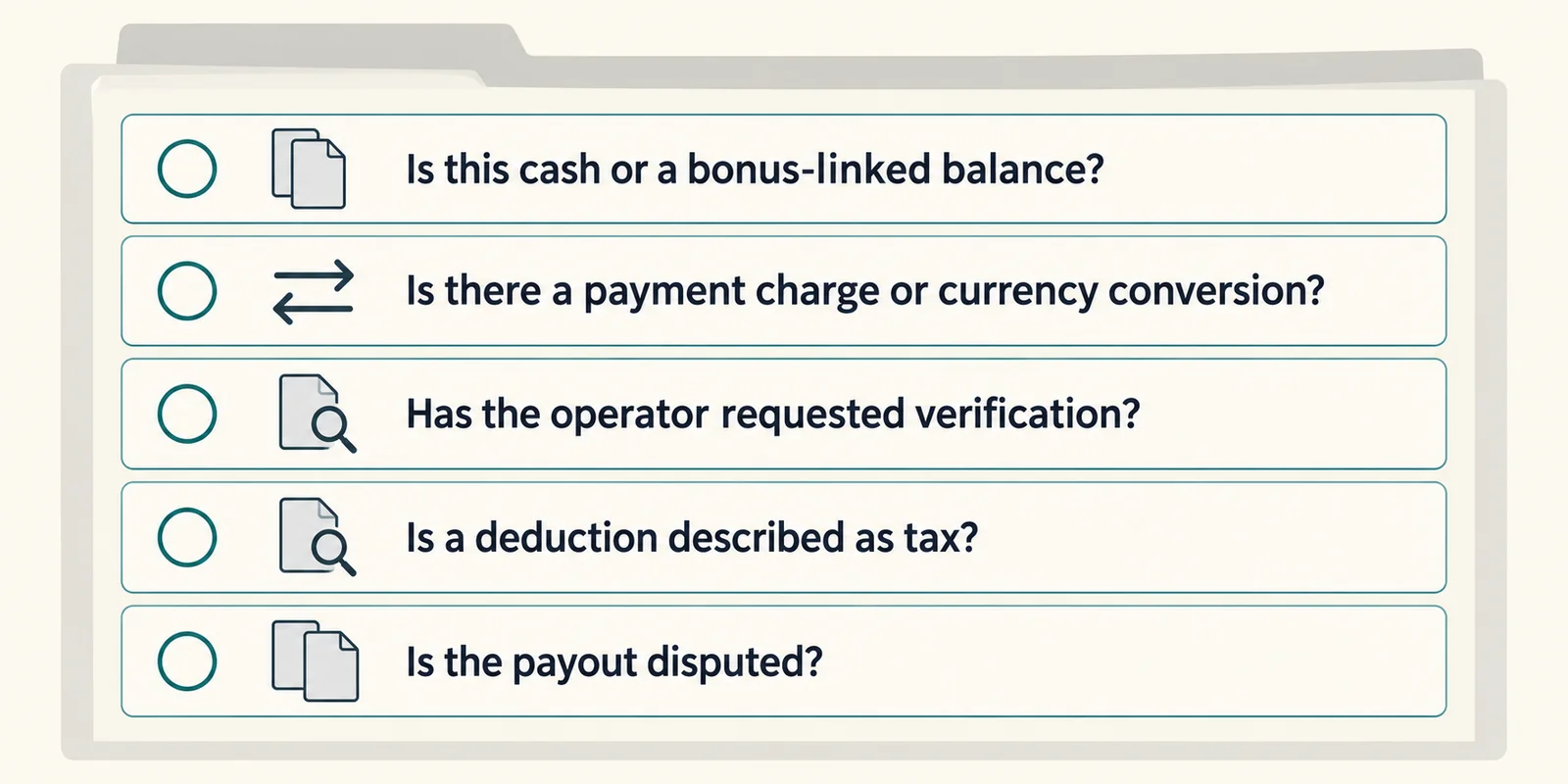
Questions to check before treating a displayed balance as available to withdraw.
Common questions about UK winnings and no-KYC claims
Does a large win automatically become taxable?
The cited HMRC introduction does not set a cash threshold at which an ordinary player’s winnings automatically become trading income. Its distinction concerns the nature of the activity. A large balance can still raise verification questions; those questions are not themselves a tax assessment.
Must I use an offshore casino to get tax-free winnings?
No. The ordinary-player principle in HMRC’s guidance is not presented as an offshore incentive. Choosing an overseas operator does not remove the need to check licensing or withdrawal terms.
Can I refuse ID because the winnings are tax-free?
Tax treatment does not remove a gambling business’s verification obligations. If you dispute a request, ask for its reason and use the complaints process rather than assuming that a tax exemption overrides it.
Does this guidance cover what happens after I withdraw?
Not comprehensively. Tax treatment of later income or transactions involving the money is a separate question. Do not extend the ordinary gambling-winnings principle to unrelated financial activity without checking the relevant rules.
Keep the tax answer separate from the decision to gamble
Use HMRC guidance to understand tax, the Gambling Commission to check British licensing requirements, and the operator’s documented terms to assess a withdrawal question. A tax-free claim is not a reason to accept unclear checks or charges, and it is never a guarantee of profit.
Gambling is for adults aged 18 and over and can cause financial harm. Do not treat it as income or chase losses. Set limits you can afford, stop if gambling is causing problems, and seek support or self-exclusion rather than another casino when you need a break.
Related guides
What to check before choosing a payment method
A practical checklist for reading deposit and withdrawal information.
Online Casino Easy Verification: A UK Guide to Faster Onboarding
Learn how online casino easy verification works in the UK, what documents you need, and how to avoid delays during identity checks.
How to assess a fast-withdrawal casino claim
An evidence checklist for payout-speed claims: licence, payment route, timing definitions, verification and a documented complaints route.