Can VIP Players Negotiate Permanent Exemption from KYC?
VIP status is not a permanent waiver of casino identity or financial checks. Understand what British regulatory guidance says and what you can reasonably ask a casino.

Can VIP status buy a permanent KYC exemption?
No. For casinos licensed by the Gambling Commission in Great Britain, the official guidance does not support a permanent exemption from identity and financial checks negotiated through VIP status. It points in the opposite direction: high-value customers require checks before joining a rewards programme and ongoing scrutiny afterwards.
If you searched for “vip casino kyc exemption high roller”, the useful distinction is between making verification less repetitive and removing it altogether. A casino may verify your identity electronically without requesting document uploads. That is still verification, not a waiver. Spending more does not turn it into a lifetime exemption.
KYC means “know your customer”: checks to establish who a customer is and understand relevant risks. AML means anti-money laundering, which includes checking whether gambling funds have a legitimate source. This article examines the exemption claim, not ways to evade either process. It is for adults aged 18 and over; the regulatory sources concern Great Britain, not a universal rule for every jurisdiction.
Why high rollers face additional scrutiny
The Gambling Commission calls these players high-value customers, or HVCs. Its guidance on high-value customer reward programmes explains that high spending, frequent gambling or both create heightened risks. The customer’s commercial value must not override regulatory obligations or welfare.
Before granting HVC status, the Commission expects operators to evidence checks covering:
- Affordability: whether spending is affordable and sustainable within the customer’s leisure budget.
- Safer gambling: whether there are signs of gambling-related harm or vulnerability.
- Enhanced due diligence: more detailed checks, including up-to-date evidence of identity, occupation and the source of gambling funds.
Source of funds means where the money actually used to gamble came from. A public impression that someone is wealthy is not the same as evidence explaining those funds.
The guidance also addresses a practical misconception: having money available today does not establish that continued spending is sustainable. It tells operators to be cautious about unexpected funds, including an inheritance or gambling windfall, when assessing affordability. Neither is a reason to dispense with checks.
Checks continue after VIP admission
The Commission expects ongoing checks, with their frequency determined by risk. Even without a change in the risk assessment, its guidance calls for an HVC account review at least quarterly. That does not mean every customer must submit the same documents every quarter; it means VIP admission does not end the operator’s oversight.
Where a customer fails the relevant checks, the guidance says HVC status should be suspended immediately until the identified risk has been addressed. Someone unable or unwilling to supply required information should not be eligible for HVC incentives. A permanent promise of “no further checks” conflicts with that approach.
Simplified due diligence is not a VIP loophole
Customer due diligence is the process of checking a customer’s identity and assessing the relevant financial-crime risks. The Commission’s simplified customer due diligence guidance allows adjusted measures where the operator determines that a relationship or transaction presents a low money-laundering and terrorist-financing risk.
That decision depends on risk assessment, not a VIP manager’s willingness to reward spending. Operators must still comply with customer due diligence requirements and monitor for unusual or suspicious transactions. They may adjust the extent, timing or type of measures; they cannot simply abandon them.
Simplified measures must stop if identification information becomes doubtful, the risk assessment no longer supports low risk, money laundering or terrorist financing is suspected, or relevant high-risk circumstances apply. For remote casinos, the guidance also says relationships and transactions cannot be considered low risk without safeguards in place.
The distinction matters when comparing claims:
| Claim or arrangement | What the official evidence supports |
|---|---|
| Identity confirmed electronically | Verification can happen without document uploads where existing information is sufficient. |
| Simplified due diligence | Adjusted measures in a qualifying low-risk situation, with continuing checks and monitoring. |
| VIP account management | A rewards relationship subject to additional scrutiny, not immunity from it. |
| Permanent exemption from future KYC or AML checks | Not supported by these sources for Commission-licensed casinos. |
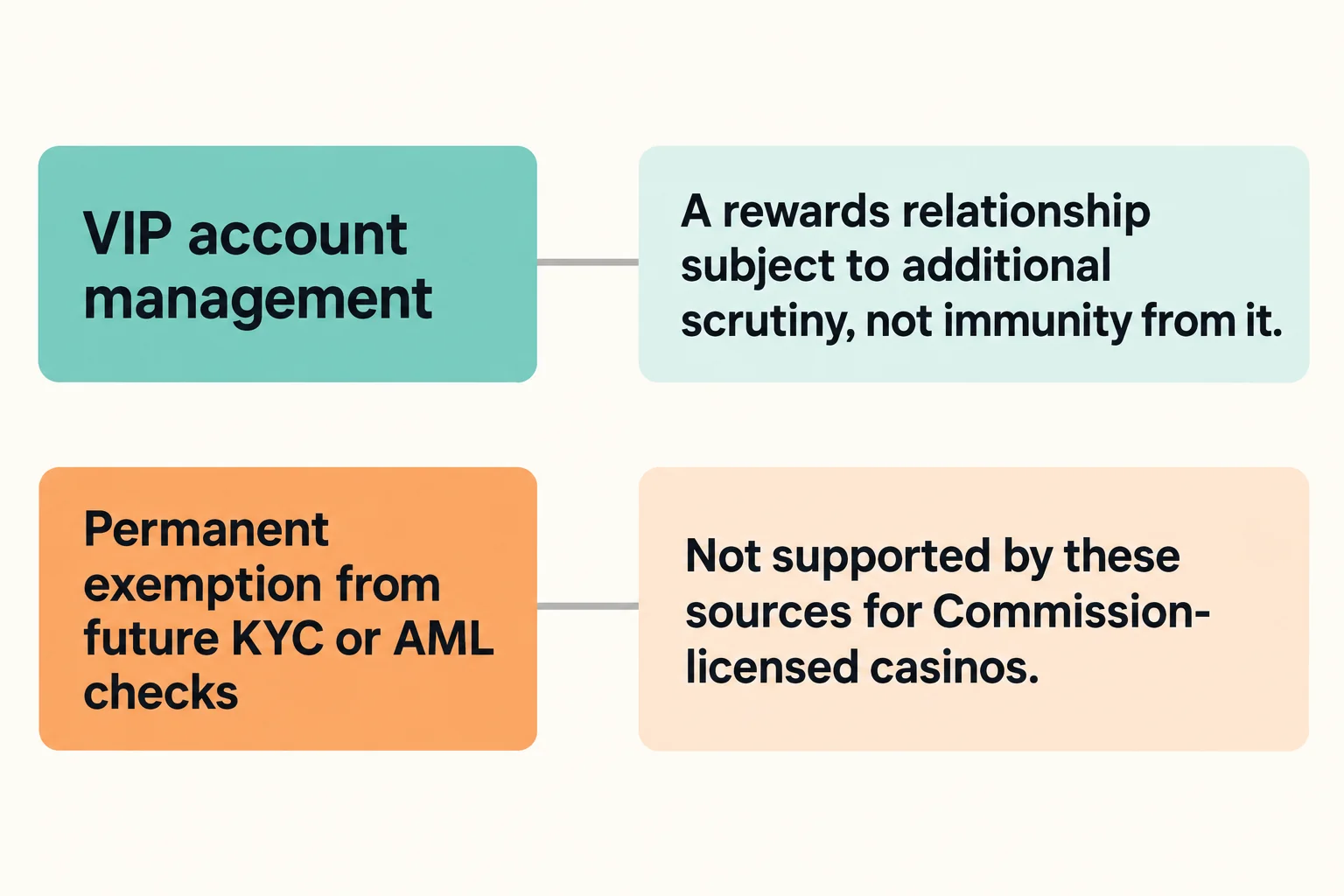
VIP account management brings additional scrutiny, not permanent exemption from checks.
What can you reasonably ask a VIP manager?
Ask for clarity about the process rather than an exemption. These are requests for information, not services every casino is guaranteed to provide:
- Which checks are already complete, and what information remains outstanding?
- Can existing, current evidence satisfy the request, or is something different required?
- Why is the additional information needed, and which documents will the operator accept?
- What is the official secure submission route, and how can you follow up on progress?
A useful written response explains the present request without promising that no future checks will occur. The Commission expects appropriate separation between staff responsible for checks and those managing HVC relationships and incentives. A relationship manager’s assurance should therefore not be treated as authority to override compliance decisions.
If the difficulty is a rejected upload rather than the principle of verification, the separate guide to casino verification documents being rejected addresses that narrower issue. Increasing spending to obtain different treatment is not a sensible solution.
Can a casino request more information at withdrawal?
The Commission’s age, ID and financial verification guide says online gambling businesses must verify age and identity before gambling. It also says they cannot make proving age and identity a withdrawal condition if they could have requested that information earlier.
There is a qualification: a legal obligation may mean information can only be requested at that later stage. Further AML checks are therefore not automatically improper just because identity was checked when the account opened. Where more information is needed before withdrawal, the Commission says operators should ask promptly, not wait until the customer wants their money.
Ask the operator to explain what is missing and why it is being requested now. Keep the request and response. If the explanation remains unsatisfactory, follow the operator’s complaints process; our guide to casino complaints and ADR in the UK covers that separate dispute-resolution topic.
Questions about VIP KYC exemptions
Does no document upload mean no KYC?
No. The Commission explains that businesses can often match account details against existing databases. If that is insufficient, they can request identification documents. A process that feels almost invisible can still include identity checks.
Can proof of wealth replace proof of funds?
Not by itself under the HVC guidance. The operator needs clarity about the actual source of gambling funds, not merely an assessment of potential wealth or income. The required evidence depends on the circumstances; these sources do not establish one universal document checklist.
Can a casino promise that verification will always be instant?
The Commission does not provide a universal timescale. Electronic verification may be instant, while document checks may take longer. These sources do not substantiate a guaranteed VIP completion time or an exemption purchased through a larger deposit.
Compare transparency, not promises of immunity
A clear explanation of checks is more useful than a promise that VIP status makes them disappear. Before sharing sensitive information, use the operator’s official channels and ask what is required. Do not deposit more or chase a VIP tier to try to avoid scrutiny.
Gambling is for adults aged 18 and over and should not be treated as income. If spending is becoming difficult to control, step away from rewards programmes and consider limits, a break or self-exclusion. VIP benefits are not a reason to gamble beyond what you can afford to lose.
Related guides
What to check before choosing a payment method
A practical checklist for reading deposit and withdrawal information.
Online Casino Easy Verification: A UK Guide to Faster Onboarding
Learn how online casino easy verification works in the UK, what documents you need, and how to avoid delays during identity checks.
How to assess a fast-withdrawal casino claim
An evidence checklist for payout-speed claims: licence, payment route, timing definitions, verification and a documented complaints route.