Zero-Wager Bonuses vs High Match Percentages: The Mathematical High Roller Choice
A large match percentage does not tell you what a bonus is worth. Compare withdrawal terms, required play and the limits of expected-loss calculations.

Which bonus gives you the clearer deal?
A zero-wager bonus removes a requirement to bet the qualifying bonus funds repeatedly before withdrawal, provided that is what the offer’s terms actually promise. A high match percentage tells you how much promotional credit an operator adds relative to a qualifying deposit. It does not tell you how much you can withdraw. Neither label guarantees profit, and the two describe different things: a match bonus can itself be wager-free.
If your question is “wager free bonus vs match bonus high stakes”, start with the money you can access and the play required, not the biggest advertised percentage. A smaller offer without compulsory repeat betting can involve less exposure to losses than a larger offer that requires substantial play. It is not automatically more valuable: eligibility, expiry and restrictions on bonus-derived winnings can change the comparison.
This guide is for UK adults aged 18 and over. It compares the mechanics, not live casino offers, and does not recommend increasing your deposit or stake to qualify for a promotion.
Zero wagering and deposit matching measure different things
A deposit match describes the size of a bonus relative to your qualifying deposit, usually subject to an offer-specific ceiling. The percentage and the maximum bonus must be read together. Once that ceiling is reached, a larger deposit does not necessarily earn more promotional credit.
A wagering requirement describes the amount of qualifying betting needed to release restricted bonus funds or winnings. “Zero-wager” should therefore answer a separate question: which funds have no further betting requirement? Do not assume that bonus credit, winnings from free spins and your own cash all have identical withdrawal rules.
| Question | Zero-wager offer | High-percentage match offer |
|---|---|---|
| What does the headline describe? | The absence of a wagering condition on specified funds | The size of promotional credit relative to a qualifying deposit |
| Does it establish cash value? | Not without checking what is withdrawable | No: credit may be subject to wagering and other conditions |
| What needs checking first? | Which funds qualify and whether winnings are limited | The bonus ceiling, wagering terms and eligible games |
| Does it remove gambling risk? | No | No |
The ASA’s advice on free bets and bonuses says promotions should disclose significant conditions clearly and upfront. These can include deposit requirements, eligibility and time limits. It also warns against describing an offer as “free” when customers must risk their own money to qualify. Wager-free is not the same as risk-free.
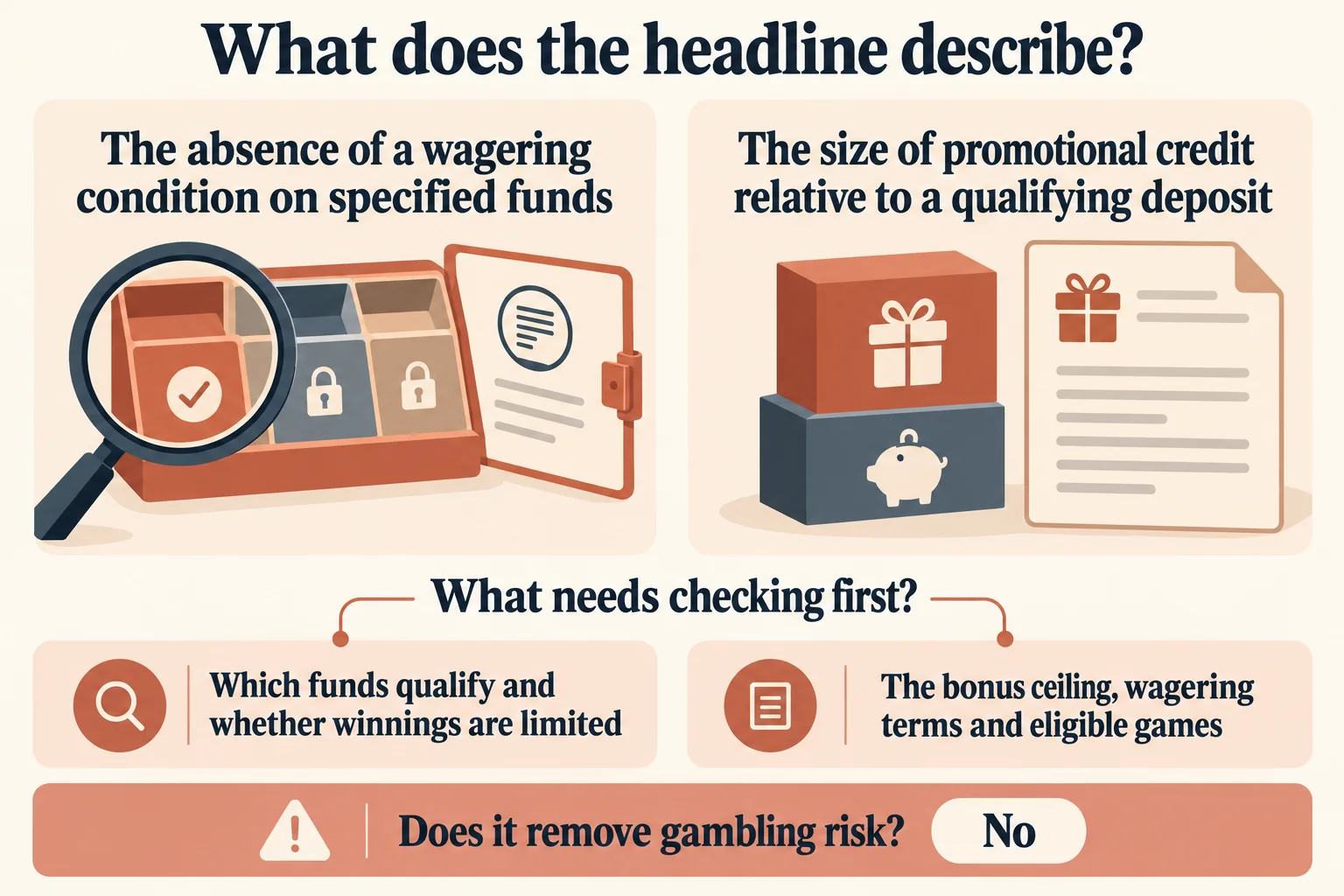
Different headline measures require different checks. Neither removes gambling risk.
The maths starts with required play, not the headline percentage
First identify the bonus amount that actually qualifies, after applying any ceiling. Then identify the funds to which the wagering multiplier applies. For a requirement calculated on the bonus alone, the relationship is:
Required qualifying wagering = qualifying bonus amount × wagering multiplier.
This is a description of the calculation, not a statement that any particular offer is lawful or currently available. If the terms do not identify the calculation base clearly, the headline does not give you enough information to compare the offer.
Game weighting changes how quickly bets count
Some games count only partly towards a wagering target. This is called game weighting or contribution. It means that the amount you bet and the amount credited towards the requirement can differ.
The Gambling Commission’s discussion of wagering requirements includes a hypothetical example of a £100 bonus with a 10-times requirement and roulette weighted at 30%. In that example, each £1 bet contributes only 30 pence towards the requirement. These are illustrative terms from the source, not an available promotion.
Where one eligible game contributes at a fixed rate, the relationship is:
Actual wagering needed = required qualifying wagering ÷ contribution rate expressed as a fraction.
A lower contribution therefore means more actual betting to complete the same target. A game with no contribution cannot help complete it. This distinction matters more than a match percentage alone suggests.
The Commission’s cited policy response states its decision to proceed with a maximum requirement of 10 times the incentive amount. Its discussion also recognises that game weighting affects how much customers need to gamble. A multiplier is therefore not a complete measure of the burden. The cited excerpt does not establish the implementation timetable, so it should not be used alone to certify an individual offer’s current compliance.
For the underlying terminology, see our guide to casino bonus wagering requirements.
Expected loss is an average, not your likely cash-out
Casino games are designed with a mathematical advantage for the operator, called the house edge. For a fixed amount of wagering on a game with an applicable, known house edge, the basic model is:
Expected gambling loss = total amount wagered × house edge expressed as a fraction.
This describes an average under the model’s assumptions. It does not predict the result of your session or establish the value of a whole promotion. A player may lose the available balance before completing the requirement, while withdrawal caps or expiry can affect what is ultimately accessible.
Return to player, or RTP, is another way of describing long-run returns in the relevant game context. The Commission’s RTP guide explains that RTP is measured across many plays, not guaranteed in each session. Its machine example explicitly warns that an advertised 85% RTP does not mean a player should expect 85 pence back per £1 staked during their session.
Subtracting a rough expected loss from an advertised bonus is consequently not enough to declare a profitable deal. The bonus may not be withdrawable cash, the game assumptions may not fit, and actual losses can differ substantially from the average. No offer-specific expected-value verdict is possible here because no complete live offer terms or game probabilities have been supplied.
Why high stakes do not solve the wagering problem
A larger stake uses more money on each outcome. It does not remove the game’s mathematical advantage or turn a long-run average into a short-session guarantee. Nor does having a larger gambling budget make a restrictive promotion better value.
Check the promotion’s maximum permitted stake before treating faster completion as an option. Where a bonus has a stake restriction, exceeding it may breach the offer’s terms. The Commission’s consumer guidance identifies stake limits among the significant conditions sites should make clear upfront.
An expiry deadline is another reason not to judge a bonus by its size. If completing the requirement would mean gambling longer or spending more than you intended, declining the offer avoids that pressure. Do not increase stakes to chase losses or finish a bonus before it expires.
Keep your own money separate from bonus restrictions
For Gambling Commission-regulated operators, the guidance on withdrawing deposits and deposit winnings says customers must be able to withdraw their deposit balance even while a bonus is pending or active, subject to general regulatory obligations. Wagering requirements must not be a condition of withdrawing that balance.
The guidance also says operators can require wagering for bonus winnings while allowing customers to withdraw winnings made with their own funds, regardless of how much they have played. Deposit and bonus balances should be displayed separately.
That does not mean every withdrawal is immediate or exempt from legitimate checks. The guidance allows certain fair, transparent, cost-reflective processing fees and reasonable limits on separate partial withdrawals. Check what happens to unused promotional funds if you withdraw your cash, rather than confusing possible forfeiture of a bonus with a restriction on access to your own balance.
A practical comparison before accepting either offer
Read the full terms alongside the headline. Record the qualifying deposit and bonus ceiling, then establish whether the promotional credit itself is withdrawable or only specified winnings are. Check any wagering multiplier, the games that count, their contribution rates and the maximum bonus stake.
Look separately for expiry, restrictions on bonus-derived winnings and excluded payment methods. The ASA guidance includes a ruling where an excluded payment method was not sufficiently prominent, despite appearing in the full terms. A condition can materially change an offer even when it is easy to overlook.
Finally, compare each offer with accepting no bonus. If the only way to obtain its advertised value is to deposit more, play longer or use games you would otherwise avoid, that is a cost to your decision, not a benefit established by the percentage.
Common questions
Is a zero-wager bonus always better?
No. Removing compulsory repeat betting can simplify the deal, but does not establish what you can withdraw or whether you qualify. Compare the complete conditions. The supplied sources do not support naming a universally superior bonus type.
Can a high match percentage compensate for wagering requirements?
The percentage alone cannot answer that. You need the capped bonus amount, contribution rates, applicable game probabilities and withdrawal conditions. Even a favourable theoretical comparison would not guarantee a profit or protect your deposit.
Does zero wagering mean instant withdrawal?
No. It describes a wagering condition on specified funds, not a payment-processing promise or an exemption from regulatory checks. Keep access to your own deposit balance separate from the treatment of promotional credit.
Keep the decision within your limits
The useful comparison is what the terms let you withdraw and what they require you to risk, not which advertisement offers the largest percentage. If either is unclear, leave the promotion alone rather than depositing to find out.
Gambling is not an income strategy. Use only money you can afford to lose, set limits before playing and stop if a bonus creates pressure to continue. For support, the Gambling Commission’s public guidance lists 0808 8020 133 for England and Scotland and 0808 2819 265 for Wales, available 24 hours a day, seven days a week.
Related guides
How to read a casino bonus offer
The headline is only the beginning. Read the conditions alongside the offer.
Wagering Requirements Explained: A UK Player's Guide
Understand how wagering requirements work, how to calculate them, and what to look for in UK casino bonus terms.
Casino Bonus Wagering Requirements Explained for UK Players
Understand how casino bonus wagering requirements work in the UK, how to calculate them, and how to find fairer offers.