Casino customer funds protection: what the ratings mean
A separate account is not enough to protect a casino balance if the business fails. Learn how to read the rating, its supporting arrangements and reminders.

A casino balance is not a bank deposit, and keeping it in a separate account does not by itself protect it if the business becomes insolvent. Casino customer funds protection concerns the arrangements for your money if the operator fails, not protection against gambling losses.
The Gambling Commission’s insolvency guide explains that gambling balances lack the Commission or government protection associated with personal bank accounts. This guide is for adults aged 18+ dealing with Commission-licensed businesses serving Great Britain. It is not a statement of Northern Ireland law, an investment strategy or legal advice.
Segregation versus protection
Customer funds are money a gambling business holds to your credit, commonly a balance kept for future gambling. The Commission’s customer funds introduction explains this scope. Insolvency means, broadly, that a business cannot meet its debts.
The Commission’s definition of customer funds includes deposits, winnings owed or left in an account, and bonuses you have become entitled to under their terms. Money already staked on an open bet, where the event has not yet occurred, is excluded. A protection rating therefore does not cover every sum connected with your gambling.
Segregation means holding customer money in accounts separate from the business’s own accounts. Online operators holding customer funds must do this, but account separation and legal protection are different questions.
Think of the distinction this way: where is the money kept, and what happens to it when the business fails? The first answer does not settle the second. A statement about segregated casino funds needs an accompanying explanation of their treatment in insolvency.
A trust adds a legal arrangement: trustees hold and manage assets for specified beneficiaries, here the customers. It is more than labelling an account “customer money”.
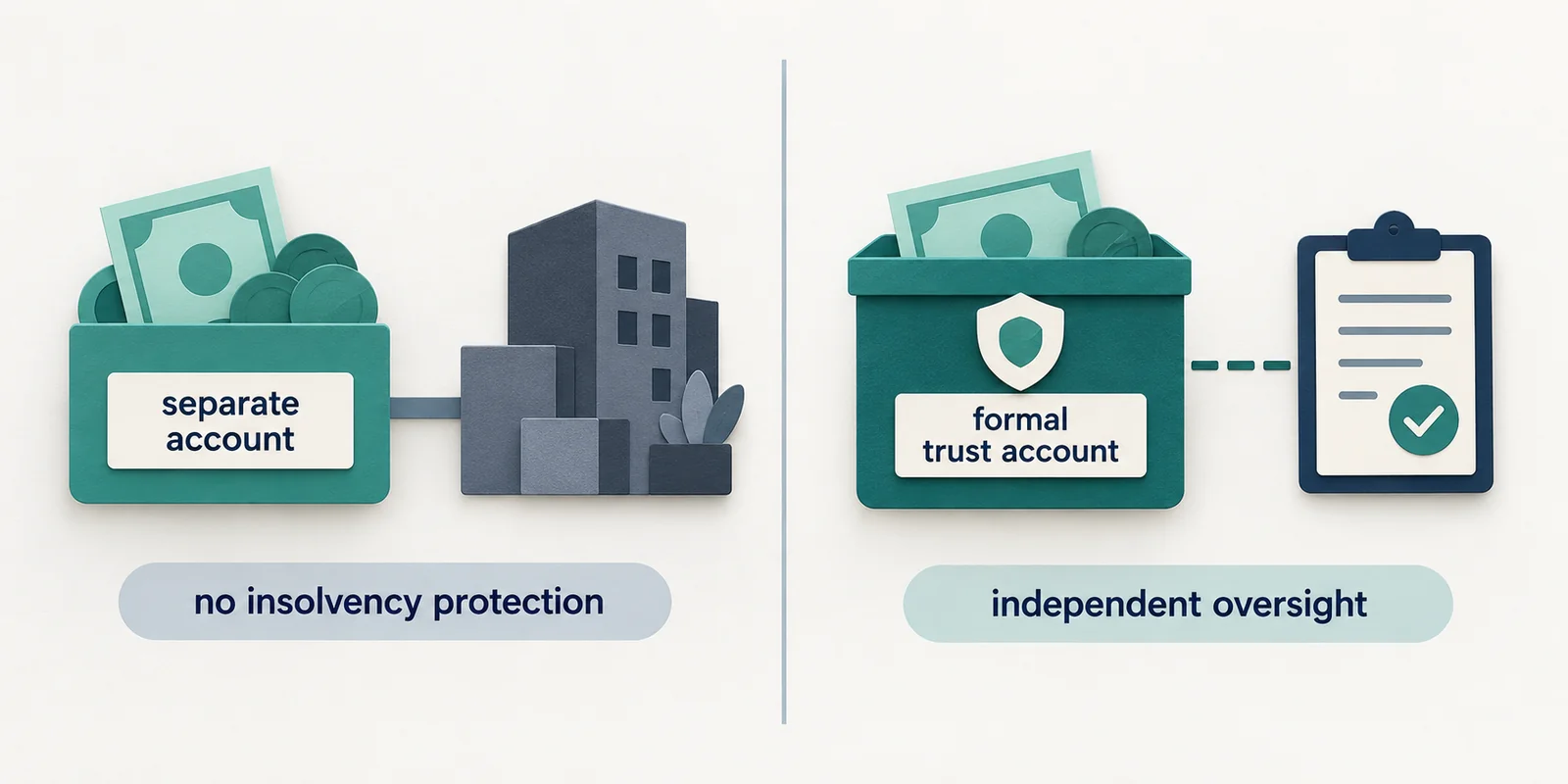
A separate account is not the same as a formal trust account.
Casino customer funds protection ratings explained
The Commission’s ratings guidance distinguishes not protected, medium protection and high protection. Operators assess their arrangements and apply the category themselves. They must not present that rating as individually approved by the Commission.
Not protected
For an online operator holding customer funds, this can mean that money is segregated but would still form part of the business’s assets in insolvency. The separate account provides no insolvency protection.
The framework also includes a no-segregation category, restricted to non-remote and ancillary remote operators. It is not the minimum standard for an ordinary online casino holding balances.
Do not read “not protected” as a minor administrative label. It identifies a risk to the money left with the business.
Medium protection
The Commission’s medium-protection explanation describes arrangements intended to return customer money if the operator becomes insolvent. Insurance is one possible method. Funds are separated from business accounts, with additional arrangements for distributing them to customers.
There is no absolute guarantee of getting your money back.
A useful qualitative example comes from these descriptions: a separate account alone can remain unprotected, while separation accompanied by suitable insurance arrangements can fall into medium protection. The meaningful difference is the additional arrangement, not a more reassuring account name. This illustrates the categories, not a claim about any particular casino.
High protection
High protection involves a formal trust account, separate from the company both legally and in practice, with independent oversight.
The Commission’s Money and rights guide describes this level as offering the best chance of recovering your money. Its explanation refers to an independent trustee controlling the funds and an external auditor checking them.
That is stronger protection, not a promise of a particular payout or repayment date. Do not turn the highest category into a claim that keeping money with a gambling business is risk-free.
Checking the actual terms
To understand what happens if a casino goes bust, read the customer-funds section rather than relying on a general reassurance about security.
Under the Commission’s protecting customer funds requirements, the terms must explain the protection level and method. The information must also appear when you deposit, with active acknowledgement before those funds can be used for gambling.
Use these questions as a reading checklist:
- What exact rating does the operator state?
- What account or legal arrangement supports it?
- Does the explanation address insolvency, rather than only account security?
- Does the deposit disclosure agree with the terms?
If wording seems inconsistent, ask the operator to identify the applicable clause and explain the arrangement in plain language. Do not fill a gap with an assumption that “separate” means “protected”.
Keep the response alongside a dated copy of the disclosure. Our guide to keeping a dated record of casino terms explains how to preserve wording without confusing the date you checked it with its effective date.
Six-monthly reminders for unprotected funds
From 31 October 2025, businesses holding unprotected customer funds must send reminders every six months. The reminder must state that the funds are not protected in insolvency and show the amount held for that customer.
The Commission’s protecting customer funds requirements also say customers must acknowledge the notification before using the held funds for gambling. Separately, changes to protection arrangements must be disclosed before implementation and at subsequent deposits, with acknowledgement required.
Treat a reminder as an opportunity to reassess the balance you leave there. Clicking acknowledgement does not improve its protection or require you to continue gambling.
A practical next step
Find your operator’s current customer-funds disclosure and write down its rating and supporting arrangement. If you cannot explain the difference between the two, seek clarification before leaving further money with the business.
No rating protects you against gambling losses. For adults aged 18+ only: do not chase losses or treat gambling as income. If concern about your balance is prompting more gambling, stop and use our gambling support and safer choices page.
Sources
- Gambling Commission: What happens to your money if a gambling business goes bust.
- Gambling Commission: Information on customer funds.
- Gambling Commission: Customer funds guidance: introduction.
- Gambling Commission: Customer funds insolvency ratings system.
- Gambling Commission: If your money has medium protection.
- Gambling Commission: Money and rights.
- Gambling Commission: Protecting customer funds.
Related guides
Slot paytable explained: read the rules before the reels
A practical guide to reading the rules behind slot symbols and payouts, with a worked reading example and clear limits on what RTP tells you.
24-Hour Withdrawal Casino: A UK Player's Guide
Learn what a 24-hour withdrawal casino actually means, how to verify processing times, and how to avoid delays with KYC and payment methods.
How to assess a fast-withdrawal casino claim
An evidence checklist for payout-speed claims: licence, payment route, timing definitions, verification and a documented complaints route.