Red Flags to Watch Out For: How to Spot Fake No-Verification Casinos
Learn how to check casino licence claims, spot misleading no-ID promises and distinguish legitimate identity checks from warning signs.

What should make you stop before sharing money or ID?
A casino promising that you will never face identity checks deserves scrutiny. For online gambling regulated by the Gambling Commission in Great Britain, age and identity must be verified before you gamble. A claim that these checks are unnecessary conflicts with that requirement. It does not, by itself, prove that a particular website is fraudulent.
If you are searching for “fake no verification casino warning signs uk”, start with something you can check independently: whether the website’s exact domain matches an appropriate, current Gambling Commission licence. Then compare its no-ID advertising with its verification and withdrawal terms. Do this before sending money or personal documents, not by making a test deposit.
This guide is for adults aged 18+. The Commission’s framework discussed here covers Great Britain, meaning England, Scotland and Wales. Do not assume that every reference to UK gambling rules also describes the position in Northern Ireland.
No document upload is not the same as no verification
A site may check who you are without asking you to upload a passport. The Commission’s age, ID and financial verification guidance explains that businesses can often match account details against existing records, such as credit reference databases and the electoral roll. If that information is insufficient, they may request identification documents.
That distinction matters when you see phrases such as “no ID” or “no verification”. A process without a document upload can still involve identity verification. A promise to skip verification entirely is different.
You may also see “KYC”, short for “know your customer”. In this context, it refers to checks used to establish who a customer is. An advertisement saying “no KYC” should not replace a clear explanation of the checks that actually apply.
Check the licence against the exact website
A licence logo is a claim, not the check itself. According to the Commission’s guidance on what gambling businesses must do, licensed businesses must display their licensed status and link to its public register.
Use the register reached through the official Commission website to check:
- The website domain, meaning the address of the site you are actually using.
- The operator and trading names, so you can connect the brand to the licensed business.
- The current licence status and the activities it permits.
- Any regulatory action recorded against the business.
Keep a short record rather than relying on a remembered badge. Copy the site’s full address and the legal business name stated in its terms. Beside them, record the domain and licensee name shown in the register, including the trading name that connects the brand to that business. Save the register entry’s link and the date you checked it.
Record the current licence status and permitted activities exactly as displayed. Compare those activities with the gambling offered on the website; do not treat the existence of any licence as permission for every activity. Note any regulatory action separately. If a name, domain or permission cannot be matched, write “not established” rather than filling the gap with an assumption.
A familiar brand name alone does not resolve a domain mismatch. If the address you are visiting does not match the record you found, stop and investigate rather than assuming a similar name is close enough. Equally, a mismatch is a reason for further checking, not evidence sufficient to publish a fraud accusation.
For a business offering gambling to consumers in Great Britain, a licence from another jurisdiction is not a substitute for the required Gambling Commission licence. The Commission states that operating without its required licence is illegal. Finding a valid register entry also does not guarantee winnings, smooth withdrawals or the absence of future disputes.
Warning signs and what they actually tell you
Treat these as reasons to pause and check, not as a scoring system that can certify a casino as safe.
| What you encounter | Why it needs attention | What to check before proceeding |
|---|---|---|
| “No identity checks, ever” | It conflicts with the pre-gambling verification requirement for Commission-regulated online gambling. | Whether the wording really means electronic checks without document uploads. |
| A licence badge without a usable register link | Licensed businesses must link to the Commission’s public register. | The exact domain, business name, licence status and permitted activities on the official register. |
| A licence record for a different domain | The record does not establish that the website in front of you is covered. | Whether the exact address appears in the relevant register entry. |
| No-ID advertising but terms allowing ID requests | The headline may leave out an important condition. | When checks apply and which documents may be requested. The contradiction alone does not prove fraud. |
| Basic identity questions appear only when you withdraw | The timing needs explanation, but a legally necessary later check is possible. | The reason given for the request, using the withdrawal guide linked below for the detailed rules. |
| Pressure to send documents before you can establish who runs the site | You have not yet established the recipient’s identity. | The business details and its genuine document-submission route before sharing sensitive information. |
The final row is a precaution about protecting your information, not an allegation about a named operator. This guide does not assess or blacklist individual casinos.
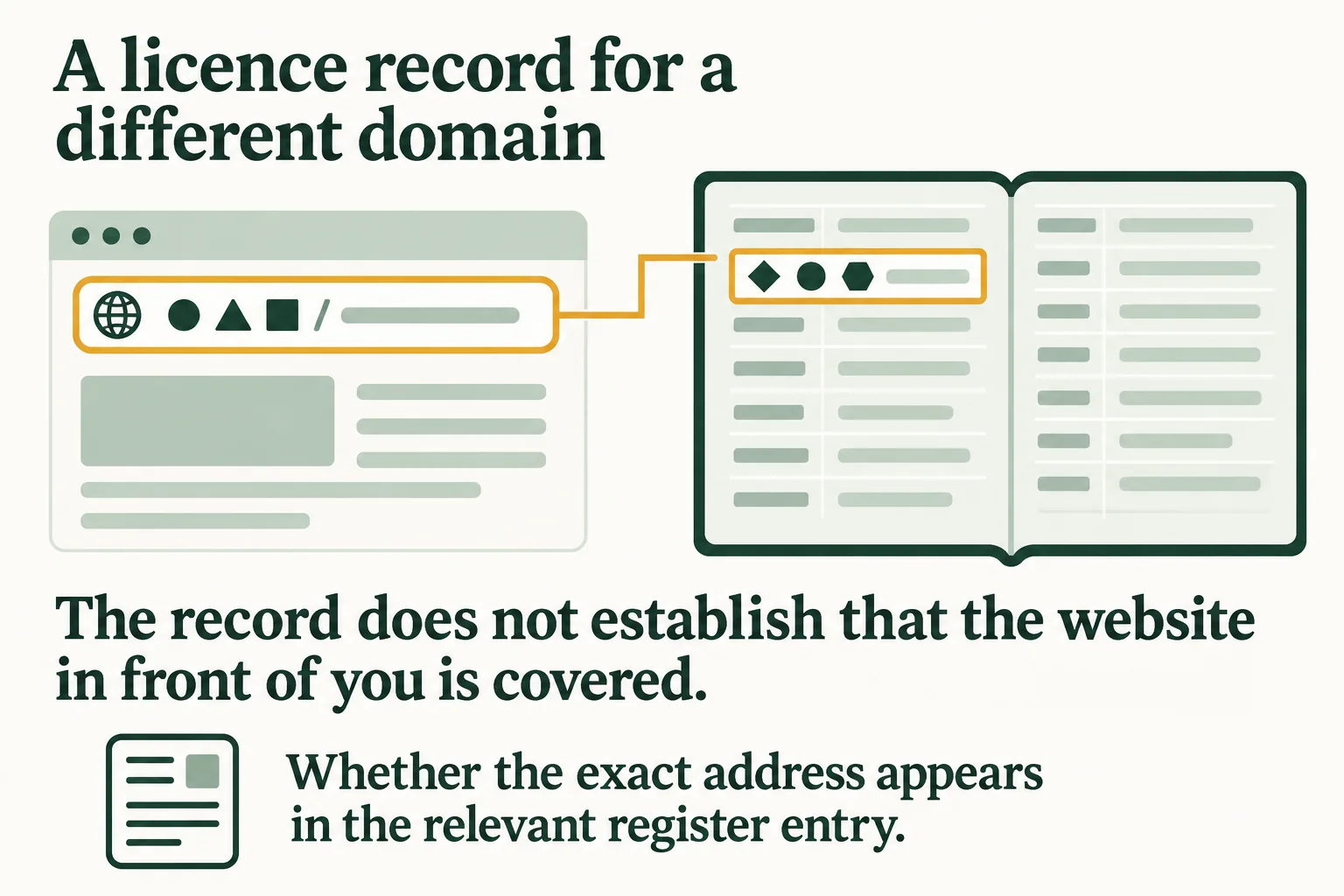
Check whether the exact website address appears in the relevant register entry.
To assess a no-ID promise, copy its exact wording and page address into your record. Then place the relevant verification clause beside it, with its section heading and URL. Include qualifications about who may need documents and when. If you cannot find a relevant clause, record that gap; silence does not confirm that checks are unnecessary.
Distinguish a promise about avoiding uploads from a promise about avoiding identity checks altogether. Where the terms allow documents but the advertisement appears unconditional, record the contradiction and ask for an explanation. Do not rewrite either passage to make them agree. This comparison identifies what the advertising leaves unclear without claiming that an untested operator is fraudulent.
A withdrawal ID request is not automatically a scam
A document request alone does not prove fraud. The Commission recognises that legal obligations can require information at the withdrawal stage. For the detailed rules on timing and checks into the source of money, see our guide to instant withdrawals and no-verification claims.
Do not send documents to an unverified contact simply because a message uses a casino’s name. If your immediate problem is a failed document check rather than an uncertain website, see our guide to rejected casino verification documents.
What to do if the checks do not add up
Separate what you found from what you infer. A confirmed fact is something your saved material directly shows, such as a domain listed in a register entry or a clause permitting ID requests. An unresolved discrepancy is a comparison you cannot reconcile, such as the site’s stated operator not matching the licensee you found. Neither label means that you have certified the site as safe or proved fraud.
Your decision to stop does not require a fraud verdict. If you cannot establish who would receive your money or documents, or cannot reconcile the licence claim, withhold them while the uncertainty remains. Do not deposit to find out whether an uncertain site pays. Keep the relevant correspondence with your record.
If you already have an account, use independently checked business details to ask for a written explanation of the discrepancy. Where a verified operator’s response does not resolve a dispute, follow its complaints process. Our guide to casino complaints and alternative dispute resolution covers that separate issue; alternative dispute resolution means having a dispute considered outside court.
If you suspect a business is offering gambling illegally in Great Britain, the Commission’s guidance on what businesses must do includes a route to report your concerns. A report is not a guarantee of recovering money. Keep a suspected false licence claim separate from an ordinary service complaint so that you can explain exactly what you found.
Questions about no-verification claims
Does not being asked for a passport mean the casino skipped checks?
No. No document upload is not proof of no verification, as explained above. Check what the advertisement actually promises before treating your experience as evidence about the site.
Does a request for bank statements prove that a site is fake?
No. The Commission describes bank statements as one way businesses can check whether a customer’s source of funds is legitimate. First establish that the business and the submission channel are genuine. A document request alone cannot settle that question.
Can reviews replace a licence check?
No. A review does not establish the current licence status of the exact domain you are visiting. Start with the official register rather than treating a rating, an advertising label or an affiliate recommendation as regulatory evidence.
A safer next step
If you cannot connect a website to an appropriate licence or understand its verification terms, leave it alone. You do not need to risk money to investigate it, and no checklist makes gambling risk-free.
Gambling is for adults aged 18+ and is not a way to earn money or recover losses. If it is causing stress or financial harm, stop and seek support. The Gambling Commission pages linked above include safer-gambling information and help routes.
Related guides
What to check before choosing a payment method
A practical checklist for reading deposit and withdrawal information.
Online Casino Easy Verification: A UK Guide to Faster Onboarding
Learn how online casino easy verification works in the UK, what documents you need, and how to avoid delays during identity checks.
How to assess a fast-withdrawal casino claim
An evidence checklist for payout-speed claims: licence, payment route, timing definitions, verification and a documented complaints route.