Instant withdrawals without verification: checking UK casino claims
No document upload does not mean no identity check. Learn what UKGC rules require and how to separate casino processing from payment arrival.
A casino promising withdrawals with no identity checks deserves scrutiny. Gambling Commission rules require licensed online casinos to verify your identity before you gamble. Not being asked to upload a passport can mean an electronic check has worked, rather than that verification has been skipped.
If you searched for “instant withdrawal casino no verification uk”, separate the promises before relying on them. Has the business checked who you are? Does its advertised withdrawal time cover the whole journey to your account? A claim about one does not answer the other.
No document upload does not mean no verification
The UK Gambling Commission, often shortened to UKGC, requires relevant remote licensees to establish a customer’s identity before permitting gambling. The information must include their name, address and date of birth. This guide concerns those licence requirements, not a claim that every website accessible from the UK follows them.
The Commission explains that companies can often match account details against existing databases, including credit referencing agencies and the electoral roll. When that information is insufficient, they ask for identification documents. An account can therefore pass an identity check without you photographing a document.
That distinction changes how to read a “zero verification” claim. Ask whether it means no manual document upload for customers successfully checked electronically, or genuinely no identity checks. The latter conflicts with the requirements for a UKGC-licensed online casino. Do not treat a convenient sign-up process as evidence that later checks are impossible.
What a document request at withdrawal means
A withdrawal request must not trigger a demand for additional information that the operator could reasonably have requested earlier. However, the licence condition expressly allows information requests needed at that time to meet another legal obligation.
Both parts matter. “They can never ask again” overstates your protection; “they can ask for anything when you withdraw” overlooks the restriction. The Commission says that information needed for anti-money-laundering checks should be requested promptly, rather than held back until you want your money.
Before allowing a deposit, operators should explain what identity documents or other information they might need, when they might need it and how you should supply it. Read that explanation rather than assuming a banner promising fewer checks overrides it.
If a request arrives unexpectedly, ask what information remains outstanding and why it is needed now. Keep the request and any earlier confirmation of verification. Use the operator’s secure submission route, and ask for clarification if the instructions are unclear. This helps you identify what is being requested without assuming every additional check is improper.
Instant verification is not instant payment
The Commission says electronic identity verification may be instant, while checking supplied documents may take longer. It does not give a universal timescale for ID checks. Neither statement promises an instant withdrawal.
Read payment wording as two separate questions:
- How long does the operator say it takes to review and release your withdrawal?
- After release, how long does the payment provider say it takes for the money to reach you?
The second stage involves the payment system carrying the transfer, sometimes called the payment rail. A time quoted only from approval leaves the earlier wait unanswered. Ask when the advertised clock starts and whether it stops at release or receipt.
The Commission acknowledges that withdrawals can be delayed by a bank’s own processes, as well as problems such as an expired debit card. That is a reason to check the actual payment route, not to assume every delay is the bank’s fault. Without verified terms for the particular service and method, there is no basis here to promise a speed or rank a casino as fastest.
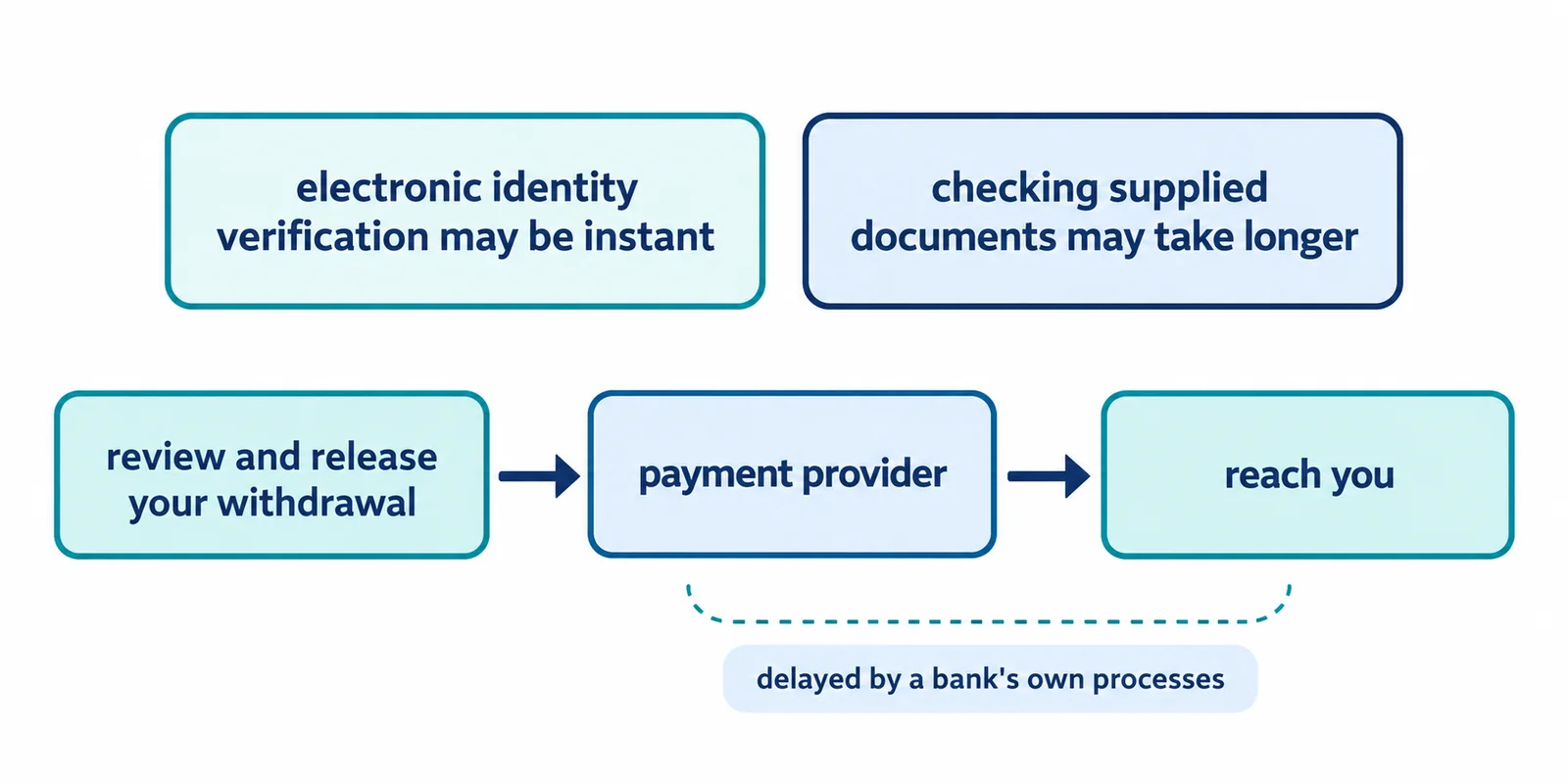
Identity checks and payment timing are separate questions.
Questions to ask about a delayed withdrawal
Ask support whether the request is still with the operator or has been sent to the payment provider. Request the relevant published timeframe and, if available, a payment reference. Save the withdrawal confirmation and written replies so you can compare the explanation with the terms.
If the response does not resolve your concern, follow the operator’s complaints procedure. Our guide to casino complaints and alternative dispute resolution explains the separate complaint route. Keep your complaint focused on what happened to your request and the response you received.
This guide is for adults aged 18 and over. Do not deposit more or continue gambling to try to speed up a withdrawal. Keep money needed for essentials out of gambling, and take a break if waiting for a payment is drawing you back into play. Ask for a clear explanation of the outstanding step rather than relying on an “instant” promise.
Sources
Gambling Commission: Age, ID and financial verification
Related guides
What to check before choosing a payment method
A practical checklist for reading deposit and withdrawal information.
Online Casino Easy Verification: A UK Guide to Faster Onboarding
Learn how online casino easy verification works in the UK, what documents you need, and how to avoid delays during identity checks.
How to assess a fast-withdrawal casino claim
An evidence checklist for payout-speed claims: licence, payment route, timing definitions, verification and a documented complaints route.