How to Handle Frozen Bank Accounts After Winning Big at Offshore Casinos
A practical guide to explaining a casino payout, requesting help with essential payments and challenging a bank restriction through the proper complaints route.

If your bank account is frozen after a large offshore casino payout, contact the bank through its official app or published telephone number. Ask what is restricted, what information it needs and what help is available for essential payments. Gather records showing where the money came from. Do not disguise the payout or route it through someone else’s account to avoid checks.
A win arriving before a restriction does not prove that the win caused it. Nor does a casino’s payment confirmation guarantee that your bank will release the money immediately. If you are searching for “frozen bank account gambling win uk advice” because you cannot pay your bills, tell the bank which essential payments are affected and ask what help it can offer. The guidance below is for adults aged 18 and over, with a focus on honest documentation and banking complaints rather than ways around checks.
First establish whether the bank or casino is holding the money
A frozen bank account and an unpaid casino withdrawal need different responses. Check your bank’s message alongside the casino’s transaction record before deciding whom to contact.
| What you can establish | What to ask next |
|---|---|
| The bank has told you that your account is restricted | Ask the bank which services are affected and what information it needs from you. |
| A particular incoming payment has not arrived, but the account otherwise works | Ask the casino for the payment date, reference and sender details, then ask the bank whether it can trace the payment. |
| The withdrawal still appears as pending inside the casino | Ask the casino what is outstanding. Do not assume that the bank has received the money. |
| The casino has blocked your player account | Use the operator’s complaint process for that issue; it is separate from a complaint about your bank. |
For the last situation, see our guide to a casino account blocked after winning. This article instead concerns access to your bank account and the bank’s handling of a payment or restriction.
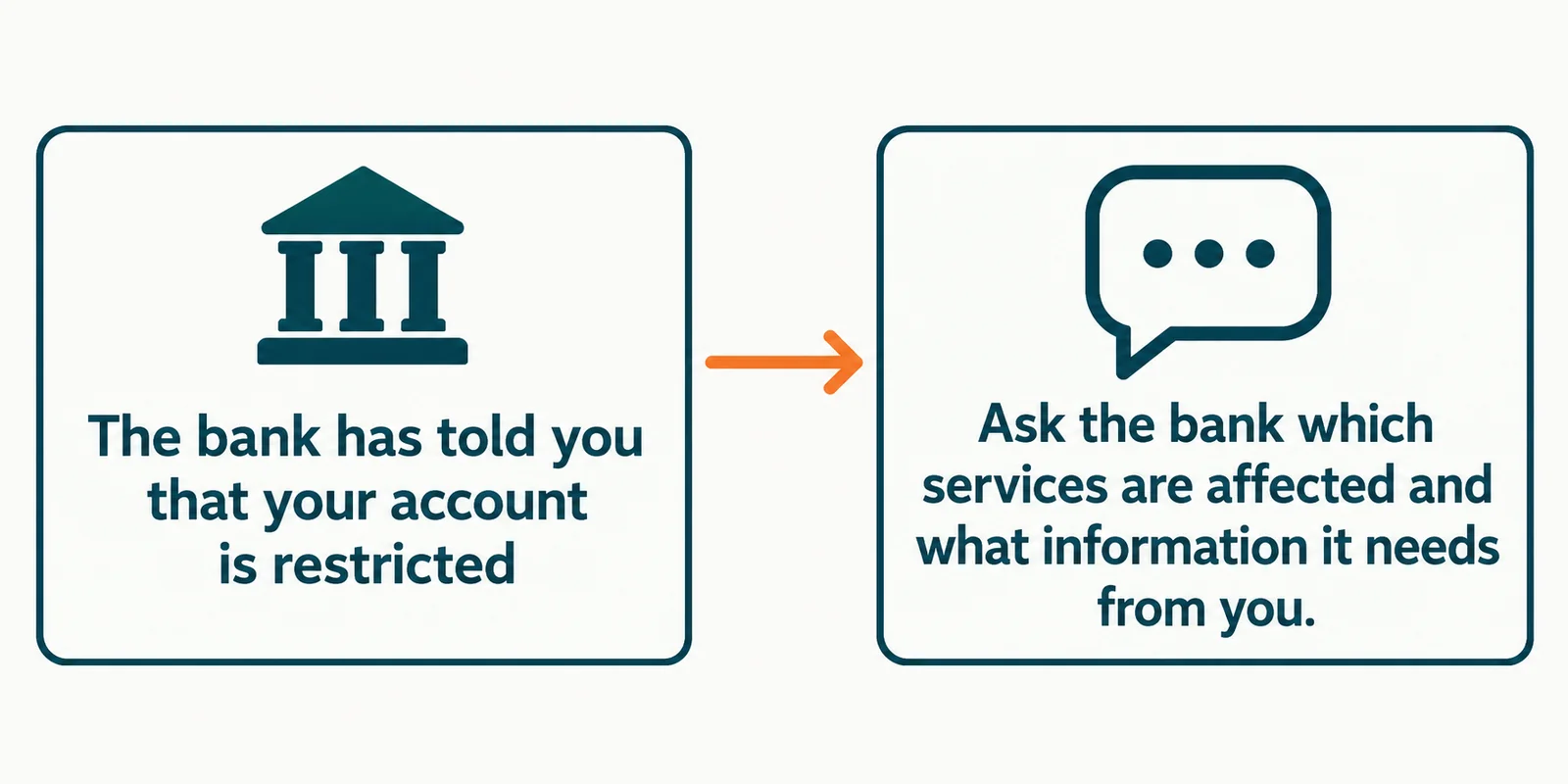
If the bank confirms a restriction, ask what is affected and what information it needs.
Why a bank may restrict an account
The Financial Ombudsman Service’s guidance on frozen accounts and blocked payments explains that banks can block payments or freeze accounts where they suspect fraud, money laundering or other illegal activity, or where a court orders it. They do not have to warn you first. The guidance says these measures are temporary in most cases, but it does not promise a release date for an individual account.
Banks also ask questions about where customers’ money comes from and how they expect to use their accounts. These checks are called customer due diligence. Monzo’s explanation of requests to update customer details says information about income and occupation helps it recognise unusual activity against a customer’s normal account use.
That explains why financial questions may be legitimate. It does not establish why your particular bank acted, and Monzo’s page is not a gambling-specific account-freeze policy. Ask your own bank what you can provide rather than assuming that every large gambling payment triggers the same response.
Contact the bank and explain any immediate hardship
Use a contact route you already trust, not a link sent by someone offering to “unlock” your funds. Keep the conversation factual: when you noticed the restriction, what the casino says it sent and which payments you cannot make.
Ask the bank:
- Is the restriction on the whole account or a particular payment?
- What documents or explanations can I supply, and through which secure channel?
- Can you confirm receipt of my documents and tell me how updates will be provided?
- What assistance is available if I cannot pay for food, rent, medication or other essentials?
Explain urgent bills specifically and keep evidence of any missed payments or charges. You can request help with essential spending, but do not assume that the bank must permit a particular payment while the restriction remains in place.
Record contact dates, reference numbers and what you were asked to do. A clear history is useful if you later complain about delays or the effect on your finances.
Show the path from your original deposit to the payout
The useful question is not simply “Can I prove that I won?” It is “Can I explain the money’s journey?” A withdrawal email may show a casino approved a payment without explaining how you funded the gambling or who actually sent the bank transfer.
The following is a practical preparation checklist, not a universal list of documents banks must accept. Follow your bank’s actual request.
Gather records that connect the transactions
Keep the casino account statement or transaction history showing deposits, play and withdrawals where available. Retain the withdrawal confirmation, payment reference, date, amount and currency. Bank statements showing the original deposits can help connect your bank account to the casino records.
If the sender name on the transfer differs from the casino’s trading name, ask the operator for a written explanation and payment details. Do not invent a relationship between a casino and a payment company merely because the amounts match.
The bank may also ask about the money used for the original deposit. Provide relevant records when requested, such as evidence of earnings or savings. A payout record and evidence of how you funded the deposit answer different questions.
Explain gaps honestly
Write a short timeline using the dates and amounts in your records. If a document is unavailable, tell the bank what is missing and ask what alternative it can consider. Send sensitive information through the bank’s confirmed secure channel and retain a copy of your submission.
Do not edit statements to conceal gambling, describe winnings as salary or split transfers to avoid scrutiny. Anti-money-laundering checks, often shortened to AML checks, concern whether money may be connected to crime. Trying to hide its origin is not a legitimate way to resolve them. Providing documents supports an explanation; it does not guarantee that the restriction will be lifted.
What an offshore casino licence does and does not establish
“Offshore” describes location, not a complete regulatory status. An overseas business may hold a Gambling Commission licence. Conversely, a licence issued elsewhere is not evidence that the operator holds one from the Gambling Commission.
The Commission’s operating licence guidance says businesses providing remote gambling facilities and advertising to consumers in Great Britain need its licence. Its explanation of what it regulates also covers remote gambling offered to consumers in Great Britain even where the key equipment is elsewhere in the world.
There is a geographical qualification for UK readers: the Commission says it does not regulate the provision of remote gambling in Northern Ireland, although advertising remote gambling there requires a Commission licence. Do not treat Great Britain and the whole UK as interchangeable in licensing claims.
For anyone comparing casinos, assess licensing separately from advertised withdrawal speed. Neither a licence nor a promise of fast payouts settles a bank’s questions about a particular transaction. The official sources cited here provide no basis for promising that offshore winnings will be released within a set time.
Complain to the bank if the restriction is handled unfairly
If you cannot resolve the issue through ordinary contact, make a formal complaint to the bank. Explain what you are challenging: for example, its handling of documents, communication, delays or the financial impact of the restriction. State what you want it to do, without assuming it can immediately end every restriction.
Include your timeline, relevant correspondence and evidence of harm, such as charges caused by missed bills. Keep the complaint reference and any written response.
When to approach the Financial Ombudsman Service
The Ombudsman’s frozen-account guidance says to complain to the financial business first. It says the business must get back to you within 15 days, either with a response or an explanation of why it cannot yet respond, and then send a response within 35 days. These are the complaint timings stated on that page, not a deadline for unfreezing your account.
If you are unhappy with the response or the business does not reply in time, the guidance says you can bring the complaint to the Financial Ombudsman Service. Its service is free. Follow its current instructions when submitting your case.
The Ombudsman considers evidence from you, the financial business and relevant third parties. It looks at matters including the reasons for the restriction, applicable rules, account terms, assistance offered and financial harm or inconvenience. Where it finds unfair treatment, it may require the bank to put things right, including compensation where appropriate. A complaint does not guarantee compensation or immediate access to funds.
A dispute about the casino itself is separate. Our casino complaints and alternative dispute resolution guide addresses that route; it should not replace a banking complaint about the bank’s own conduct.
Common questions about frozen accounts after a win
How long will the account remain frozen?
The supplied official guidance does not give a universal release time. Ask the bank whether anything remains outstanding from you and when you should expect an update. Do not confuse a complaints response deadline with a release date.
Does a casino receipt prove the bank must release the money?
No such guarantee appears in these sources. A receipt may support your account of a payout, but the bank may need other information. Ask it which part of the transaction history needs clarification.
Should I send the payout elsewhere instead?
Do not reroute funds to evade an existing restriction or checks. Ask the bank and operator how to handle a delayed or returned payment lawfully, keeping an accurate record of their instructions. Another account is not a substitute for explaining the source of the money.
Protect essential spending while the issue is unresolved
Do not gamble more to replace inaccessible funds or borrow to keep playing. Treat the unresolved payout as unavailable when considering what you can afford to spend. This guidance is for adults aged 18 and over, and gambling should never be treated as a reliable income source.
If gambling is affecting your finances or wellbeing, seek support. The Gambling Commission’s linked guidance lists help on 0808 8020 133 in England and Scotland, or 0808 2819 265 in Wales, available 24 hours a day, seven days a week.
Your next practical step is to contact the bank through a trusted channel with the payment details to hand. Ask for its document requirements, explain any urgent hardship and keep a written record so that a formal complaint, if needed, rests on evidence.
Related guides
24-Hour Withdrawal Casino: A UK Player's Guide
Learn what a 24-hour withdrawal casino actually means, how to verify processing times, and how to avoid delays with KYC and payment methods.
UK Casino Facial Recognition: Your Rights and Alternatives
You can question a casino’s facial recognition request without trying to bypass identity checks. Learn what to ask about consent, alternatives and data use.
Bespoke Reload Bonuses: Custom Wagering Requirements for Big Depositors
A personalised reload offer is not a promise of better terms. Understand wagering limits, VIP checks and the written conditions that matter.