Bankroll Allocation at High Limit Casinos: Limits for Big Bets
A practical guide to separating essential money from a gambling budget, setting loss limits and understanding why high stakes do not change casino odds.

What a high roller casino bankroll strategy can actually do
A high roller casino bankroll strategy should start with the amount you can afford to lose, not the size of bet a casino will accept. Keep essential money outside that budget, set spending and time limits before gambling, and stop rather than replenish the budget after losses. None of this guarantees that you will keep the money you set aside.
Your bankroll is simply the money you have allocated to gambling. It is not an investment fund, and calling its allocation a professional strategy does not make big bets a reliable source of income. The sources used here support budgeting and harm-reduction advice, not a profitable high-limit betting system.
This guide is for UK adults aged 18 and over comparing casinos. Its focus is how to define and protect financial boundaries, rather than rank VIP offers or recommend a particular operator. Choosing not to gamble is always an option.
Set the household boundary before the casino budget
Start with your finances away from the casino. In its guidance on dealing with gambling losses, GamCare recommends reviewing bank statements, listing essential expenses such as rent or mortgage payments, utilities, food and transport, and comparing these with income.
Money needed for those commitments is not available for gambling. Nor should a budget depend on borrowing, missing debt repayments or using savings you need for another purpose. Having money left after bills does not mean you need to allocate any of it to a casino.
GambleAware’s advice on gambling recommends deciding a spending limit in advance and committing to it. It also warns that no gambling comes without risk. Treat your limit as the most you are prepared to lose, not a spending target to reach.
Separate the overall limit from the session allowance
An overall limit covers a defined period, such as a week or month. A session allowance is a smaller boundary within that total, not extra money on top of it. If you choose to divide a budget between visits or sites, all those allocations must remain within the same overall ceiling.
Write down the period, the overall limit and the amount already spent before deciding whether any money remains available. Moving to another casino should not reset the record. A single account balance cannot show what you have spent elsewhere.
GambleAware suggests writing your limit down, separating funds into another account or telling someone you trust. Keeping funds separate can make the boundary clearer, but it does not remove gambling risk or make it easy for everyone to stop.
Check whether the minimum stake fits your boundary
A casino’s minimum stake is the smallest amount it accepts for a particular bet. Its maximum stake is the largest it permits. Neither figure tells you what you can afford.
For high-limit play, ask a direct question: would losing the minimum permitted bet take more from your budget than you are comfortable losing on one outcome? If so, the game does not fit your limit. Increasing the budget to qualify for the table reverses the decision: the casino’s terms start determining your spending rather than your own finances.
There is no universal safe percentage of a bankroll to stake in the supplied evidence. A fixed percentage can describe how someone divides money, but it cannot establish that a bet is affordable or prevent the entire allocation from being lost. A bigger bankroll does not turn an unsuitable stake into a sound financial decision.
Understand what RTP and the house edge cannot promise
Casino games can be designed to give the operator an advantage. The Gambling Commission calls this the house edge: a measure of the percentage the casino expects to keep on average from hands or spins, given normal patterns of play. Allocating money between sessions does not remove that advantage.
For gaming machines, return to player, or RTP, describes an average proportion of staked money returned as prizes over a very large number of plays. It is not a forecast of what you will get back during your visit.
The Gambling Commission’s explanation of RTP gives a useful example: a machine displaying 85% RTP does not mean you should expect to win an average of 85 pence for each £1 staked in a playing session. You cannot use that displayed figure to calculate a dependable personal loss allowance.
The same source explains that, on random machines, the chance of a win in the current game is not affected by previous wins or losses. A losing run therefore does not make the next result a recovery opportunity on those machines. The Commission discusses compensated machines separately, so this explanation should not be treated as a description of every machine’s mechanics.
Put spending limits into practice before playing
An account setting is useful only if you understand what it measures. When comparing casinos, read the relevant help pages and terms rather than assume that similarly named controls work identically. The checklist below identifies questions to ask, not features verified at any particular operator.
| Control or condition | What to check before depositing |
|---|---|
| Deposit limit | How much money can enter the account, over which period, and whether the setting covers the boundary you intend |
| Loss or spending control | How the operator defines the amount counted, including how it treats winnings |
| Time control | Whether it only reminds you of time spent or actually ends access |
| Changes to limits | When a requested increase takes effect and how a reduction is applied |
| Game stakes | Whether the minimum permitted bet fits the amount you are prepared to lose |
| Withdrawal conditions | What documents and terms apply before money can be paid out |
A deposit and a loss are different things: the first moves money into an account; the second describes money lost through play. Do not assume a deposit cap answers every question about spending, especially if you continue playing with money already in the account.
Keep a record alongside any account tools. GamCare recommends using bank statements and a gambling diary to understand spending. Include activity across sites, rather than judging the month by the most recent winning or losing session.
For separate questions about balances held by an operator, see our guide to casino customer funds protection. That topic is distinct from deciding how much you can afford to risk.
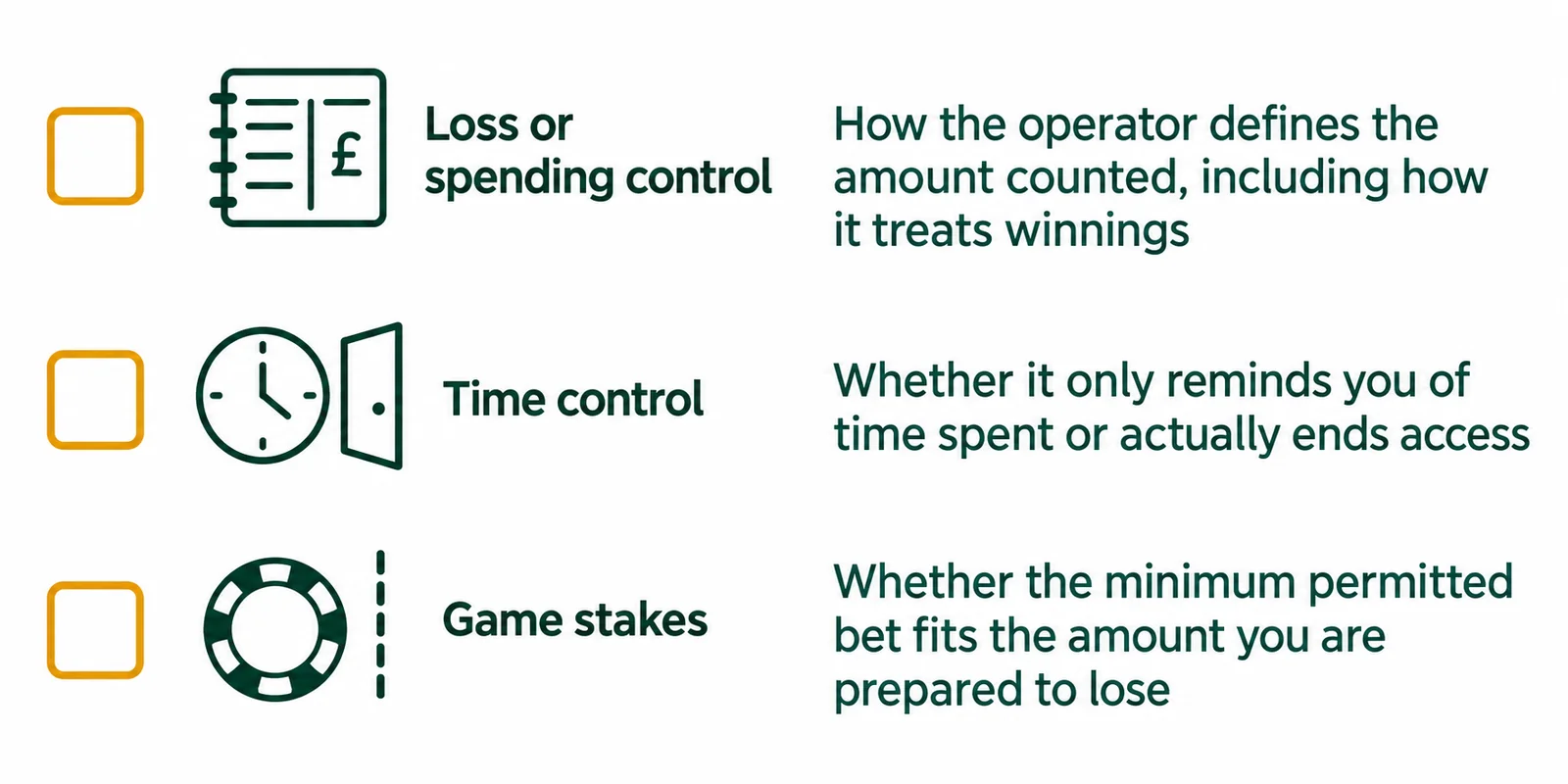
Check spending definitions, time controls and minimum stakes before playing.
Keep bonuses out of the affordability decision
Do not increase your gambling budget to qualify for a VIP tier, reload offer or other promotion. Decide your limit without counting a possible future reward as money available to spend.
Before accepting an offer, check whether it imposes conditions on play or withdrawals. Requirements vary, and this article does not verify any casino’s promotion. Our guide to casino bonus wagering requirements covers the separate question of understanding conditions attached to bonus play.
The practical boundary remains the same: if an offer would require spending beyond your pre-set limit, leave it. A promotion is not a reason to revise what you can afford to lose.
Make the stopping rule about leaving, not recovering
Set a time limit as well as a money limit. GambleAware recommends both, along with breaks, and says that once you have lost the money set as your limit, it is time to walk away. Reaching either boundary is a reason to end the session; you do not need to reach both.
Chasing losses means continuing or increasing gambling in an attempt to win back money already lost. That includes treating a fresh deposit or another casino account as a way to recover the session. GambleAware warns that this can lead to bigger losses.
A written stopping rule can be plain: no replacement deposits after the loss limit, no borrowing to continue and no extension because a win feels due. These are boundaries to reduce exposure, not a system for controlling results. You can also stop earlier, particularly if you feel upset, pressured or preoccupied with recovering money.
Questions about high-limit bankroll allocation
Can a bigger bankroll guarantee that I outlast a losing run?
No. The sources do not support a bankroll size that guarantees recovery or profit. Money available to continue playing is still money at risk, and the house edge is not removed by having more of it.
Should I increase stakes after a loss?
Not as a recovery plan. Increasing the next stake puts more money at risk on that outcome. On the random machines described by the Gambling Commission, previous losses do not improve the chance of winning the next game. Stick to your boundary rather than trying to force the account back into profit.
Is staying within my budget proof that gambling is harmless?
No. Financial limits are only part of the picture. GamCare’s guidance on signs of gambling harm also identifies difficulty stopping, thinking about gambling a lot, hiding gambling and effects on relationships, work or wellbeing.
What if I have already spent money needed for bills?
Step away from gambling rather than try to replace it with a win. GamCare recommends creating distance from the urge to continue, including blocking gambling sites and payments and asking someone you trust for help protecting your money. It can also signpost you to specialist debt advice.
If the limits are no longer holding
Repeatedly changing your limit, hiding losses or feeling unable to stop is a reason to seek support, not design a more elaborate staking plan. GamCare offers free, confidential support through the National Gambling Helpline on 0808 8020 133, available 24/7. Its guidance covers blocking tools, self-exclusion and practical money support.
For your next step, look at essential payments and the actual record of gambling spending before considering any further play. If gambling is affecting either your finances or your wellbeing, protect what remains and get support. There is no need to win anything back before you can stop.
Related guides
Set your limits before you play
Take time to decide your budget, time limit and stopping point.
Best High Roller Casino Sites: A UK Player's Guide
Looking for the best high roller casino sites? Discover what VIP players need, from higher limits to faster withdrawals, in this practical UK guide.
High Limit Blackjack: A UK Player's Guide
Discover what high limit blackjack means for UK players, including table minimums, game variations, and how to find suitable online tables.