How Slot Return-to-Player (RTP) Differs in Independent vs UKGC Casinos
Compare the RTP of the actual slot game, not a casino label. Understand theoretical returns, UKGC testing and the limits of reported payout figures.

Does an independent casino have a different slot RTP?
A casino being described as “independent” does not tell you whether its slots return more or less than those at a UK Gambling Commission (UKGC) licensed casino. The useful comparison is the expected return of the actual game being offered, supported by evidence about its maths and testing. The supplied regulatory sources do not establish that either group has higher slot returns.
There is also a problem with the labels. Independent ownership and UKGC licensing describe different things: who owns a business and which regulator licenses it. They are not opposing categories. If “independent” is being used to mean a casino outside UKGC licensing, identify its actual regulator rather than treating the word as a quality standard.
This guide is for adults aged 18 and over. It explains how to assess RTP claims, not where to gamble or how to secure a win.
What return to player actually measures
A slot’s designed return to player, or theoretical RTP, is the proportion of stakes its mathematical design is expected to pay out over extensive play. It is not a promise about the amount you will get back from a deposit, a session or your next spin.
Actual RTP is different: it describes payouts recorded over a particular body of play. The Gambling Commission’s RTP calculation guidance explains that it is calculated from the game’s win and turnover figures. Turnover means the total amount staked, not simply the money deposited.
A published example, not a forecast for your balance
The Commission gives an example of a game designed with a 91.68% RTP. After a month, it has recorded £1,200,000 in turnover and £1,085,000 in wins, producing an actual RTP of 90.42%. These are the regulator’s illustrative figures, not results from a casino reviewed here.
That lower recorded return does not, by itself, prove a fault. The same guidance says the game’s volatility and the amount of play must be considered. Volatility describes how widely outcomes can vary; in monitoring, it helps determine how far the measured return may reasonably sit above or below the designed return.
For a reader, the distinction is practical: a published theoretical percentage and a recent payout percentage answer different questions. Neither establishes what will happen to your own money.
What UKGC testing adds to the comparison
The Commission’s explanation of online game fairness says online gambling products must undergo testing by an approved test house before release. Businesses must also check games after launch to see whether they are achieving their designed RTP.
The testing strategy describes checks on the software that generates random results, known as a random number generator or RNG. It also describes examination of game maths, source code and gameplay against the published rules. These are checks on whether a game works as specified, not assurances that an individual player will win.
The strategy distinguishes between requirements needing independent assessment and those the licensee can verify. It would therefore be misleading to say that every feature receives exactly the same external test.
Crucially, these sources describe testing against a game’s expected return. They do not establish one universal RTP for all UKGC slots, or a numerical advantage over casinos licensed elsewhere. Nor do they establish the testing arrangements of any particular non-UKGC operator.
rtp comparison independent vs ukgc casinos: what the evidence shows
| Question | UKGC-licensed casino | Casino described as independent |
|---|---|---|
| What does the label establish? | A licensing category, subject to checking the actual operator’s licence. | Too little on its own: clarify ownership and regulator. |
| Which RTP should be compared? | The designed RTP documented for the actual game offered. | The same information is needed; the label cannot substitute for it. |
| What testing is supported by these sources? | Approved test-house checks and ongoing performance monitoring described by the Commission. | No operator-specific testing conclusion can be drawn from these UKGC sources. |
| Does the label prove a higher return? | No comparative numerical advantage is established here. | No comparative numerical advantage is established here. |
| Does RTP guarantee your session result? | No. | No. |
A higher advertised number is not enough for a reliable ranking. First establish whether both figures describe theoretical RTP, whether they apply to the games actually offered and whether the documentation is current. A recent measured payout figure cannot simply be placed beside a theoretical percentage and treated as the same measure.
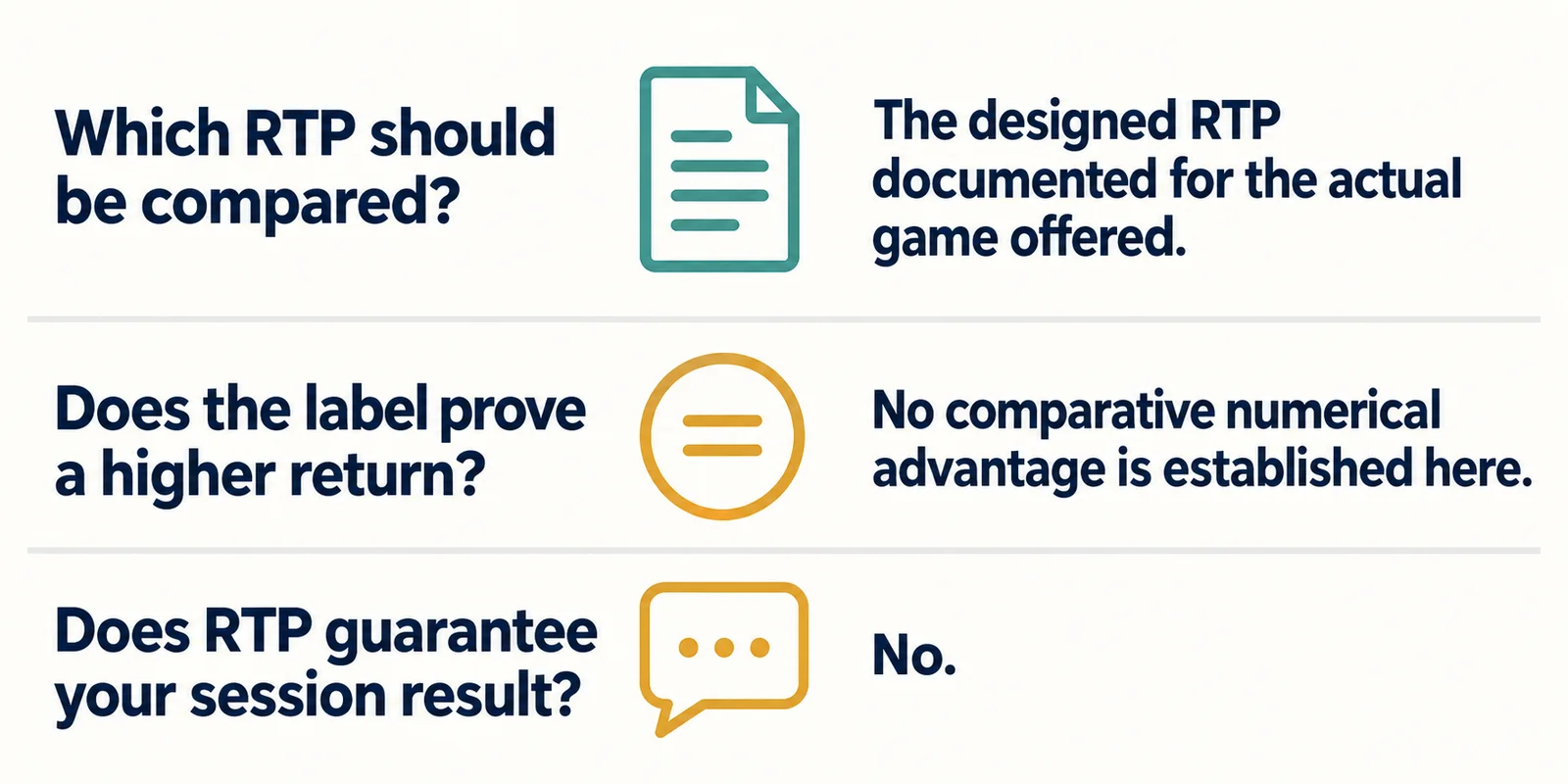
Compare the actual game’s documented RTP, not promises implied by a casino label.
How to check the game and its RTP evidence
Start with the game’s information or rules panel and the operator’s supporting documentation. Record what is actually disclosed rather than filling gaps with a figure found on an unrelated review page.
- Identify the game and provider. Record any version or configuration identifier shown, together with the date checked.
- Record the stated theoretical RTP and where it appears. If the documentation gives several possible values, establish which applies to the offered game before drawing a conclusion.
- Check what any testing evidence covers. A general testing claim is not the same as documentation connecting a particular game and its maths to the offered version.
- Keep measured payout statistics separate. Note the period, volume of play and whether the data cover one casino or an aggregated set of games.
The version check is a safeguard against comparing mismatched information, not a claim that a particular slot has multiple RTP settings. No named slot configuration has been independently verified for this article.
The supplied sources do not support a current operator-by-operator RTP ranking or a claim that offshore casinos offer better returns. Any comparison of live RTP values needs documentation linking those values to the actual game versions and their maths or testing.
If the relevant percentage or version cannot be established, the honest entry is “not verified”, not an estimate. There is no need to deposit or play to fill that evidence gap.
Why daily payout figures can mislead
A daily figure looks current, but recency alone does not make it informative. The Commission’s guidance on measuring actual RTP explains that a small amount of play can leave the acceptable range too wide for meaningful conclusions.
Its example monitoring approaches include daily measurements based on the previous 30 days of play, with a wider rolling period considered alongside them. This is an approach operators might use, not a promise that every casino publishes a daily dashboard. The guidance also notes that a supplier may hold aggregated figures across multiple operators. No daily operator RTP feed has been verified for this article.
A daily update could therefore describe a rolling period rather than yesterday’s play, and an aggregated return need not describe one casino alone. Ask what the number covers before interpreting it.
Nor does a low recent return mean a game owes you a payout. Regulatory monitoring is intended to detect potential problems in a game’s operation, not to identify a profitable moment for a player to start or continue gambling.
Keep RTP separate from bonuses and withdrawal terms
RTP concerns game returns. It does not answer whether a bonus has restrictive conditions or whether an account withdrawal is being handled properly. For those separate questions, see our guides to casino bonus wagering requirements and casino complaints and ADR in the UK, where ADR means alternative dispute resolution.
Keeping those subjects separate also prevents a misleading comparison: a headline RTP percentage is not a measure of the overall suitability of a casino or the protection available if something goes wrong.
Use the comparison to understand risk, not chase returns
The strongest comparison identifies the actual game, distinguishes designed returns from measured payouts and makes the limits of its evidence visible. Where the documentation ends, the conclusion should stop too.
Do not gamble to test an RTP claim, recover losses or wait for a game to “catch up”. If you choose to gamble, set limits you can afford and stop when they are reached. If gambling is causing harm, seek support through the help information on the Gambling Commission’s player guidance page. Not gambling is always an option.
Related guides
High Limit Sports Betting & Casino Hybrids Outside GamStop for British Punters
Understand what high limits mean across sportsbooks and casinos, why British licensing matters, and what the official sources do not establish.
Casino customer funds protection: what the ratings mean
A separate account is not enough to protect a casino balance if the business fails. Learn how to read the rating, its supporting arrangements and reminders.
Bankroll Allocation at High Limit Casinos: Limits for Big Bets
A practical guide to separating essential money from a gambling budget, setting loss limits and understanding why high stakes do not change casino odds.